2025 was a year filled with travel disruptions as a result of a shifting geopolitical landscape, regional conflict, and in some cases, domestic political dynamics. Tamsin Hunt examines some of the security trends that will continue to affect global travel over the coming year.
Rising geopolitical instability has seen a ripple effect across the global travel landscape, presenting new and emerging challenges for travellers. In some parts of the world, external and domestic political considerations have prompted governments to reform visa requirements and entry procedures. In others, emerging or escalating conflicts have triggered airspace closures that – while temporary – have had a significant impact on regional air travel.
A shifting regulatory landscape
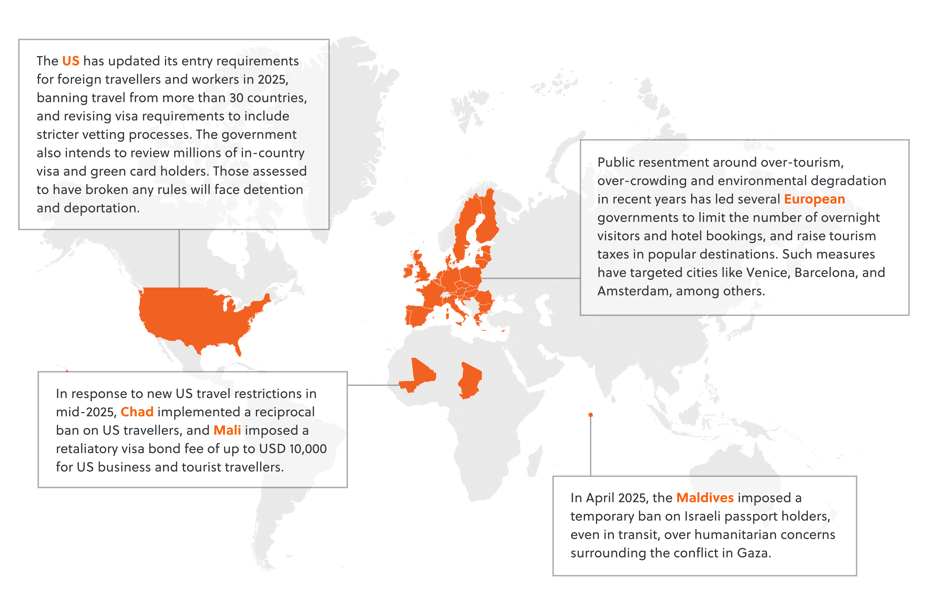
For some countries and regions, rising geopolitical and political tensions have resulted in new visa requirements and travel restrictions.
Conflict-related disruptions to aviation
In other parts of the world, military tensions and/or open conflict has prompted localised and regional airspace closures, diverted flight routes, and in severe cases, triggered evacuations. Persisting tensions in these regions will drive further disruptions in 2026.
Europe
Disruptive incidents attributed to Russian grey-zone activity are increasingly affecting European travel. Hundreds of drone sightings have been reported at dozens of airports across Europe, prompting temporary – sometimes hours-long – airport closures and flight cancellations, affecting airports in Belgium, Sweden, Denmark, Norway, and Germany, among others. Additionally, Lithuania and Poland both suspect their neighbour (and Russian ally), Belarus, of using weather balloons to disrupt their airspaces as part of a broader hybrid warfare campaign against Western Europe.
Latin America
Amid escalating tensions between the US and a number of Latin American governments – particularly Venezuela – as President Donald Trump’s administration cracks down on regional drug-trafficking, numerous regional and international airlines have suspended flights to Venezuela and through its airspace as US military activities increased in the Caribbean since September 2025. After US strikes on Caracas on 3 January, and the detention of Venezuelan President Nicolás Maduro, hundreds of regional flights were cancelled, temporarily stranding travellers in destinations close to Venezuela, including Puerto Rico, the US Virgin Islands, and Aruba. Although airspaces soon reopened and flights resumed, persisting tensions will likely disrupt travel across the Latin American and Caribbean regions over the coming year.
Middle East
During the 12-day war between Israel and Iran in June 2025, several countries closed their airspaces – indefinitely or intermittently – including Israel, Iran, Iraq, Syria and Jordan. Additionally, airspace closures expanded further after Iran’s airstrike on the US’s Al Udeid military base in Qatar, affecting Qatar, Kuwait, Bahrain and the UAE. This conflict severely disrupted aviation along key routes across Europe, the Middle East and Asia.
India and Pakistan
Amid steadily increasing tensions leading up to the May 2025 conflict, India and Pakistan banned one another from entering their respective airspaces, bans that have been extended every month since. The closures have had a greater impact on India’s aviation industry compared to Pakistan, with approximately 20 percent of all Indian international flights previously using Pakistani airspace. Subsequent flight delays have ranged from several minutes to several hours, with routes to Central Asia, Europe and the Americas the worst affected.
Detention as political leverage
Certain countries have long used detention as a geopolitical tool, leveraging the arrest of foreign citizens in negotiations with those individuals’ home countries.

Russia: Russia’s war in Ukraine and its hybrid campaign against Western Europe continue to drive heightened regional tensions. For Russia, detained Western travellers, businesspeople, and NGO workers continue to represent valuable opportunities as leverage in negotiations for the release of its own citizens in Europe.

Iran: Tensions with Israel, the US and Europe remain high, driven largely by suspicions around Iran’s nuclear programme, and Iran’s military and financial support of regional armed groups. Citizens from these countries will continue to face a high risk of detention in Iran in 2026.

Burkina Faso: In efforts to expand sovereign control and advance a nationalist agenda, Burkina Faso’s military-led government has clamped down on foreign-owned businesses and NGOs operating in the country. In 2025, Burkinabe authorities revoked NGO operating licenses, expelled foreign media organisations, and expanded efforts to extend state control over foreign-owned mines.