
Since July 2026, heavy clashes have resumed along several frontlines in Yemen, with increasing attacks on Saudi Arabian territory, as well as commercial vessels in the Red Sea. Tamsin Hunt examines the security and commercial repercussions of renewed tensions in Yemen.
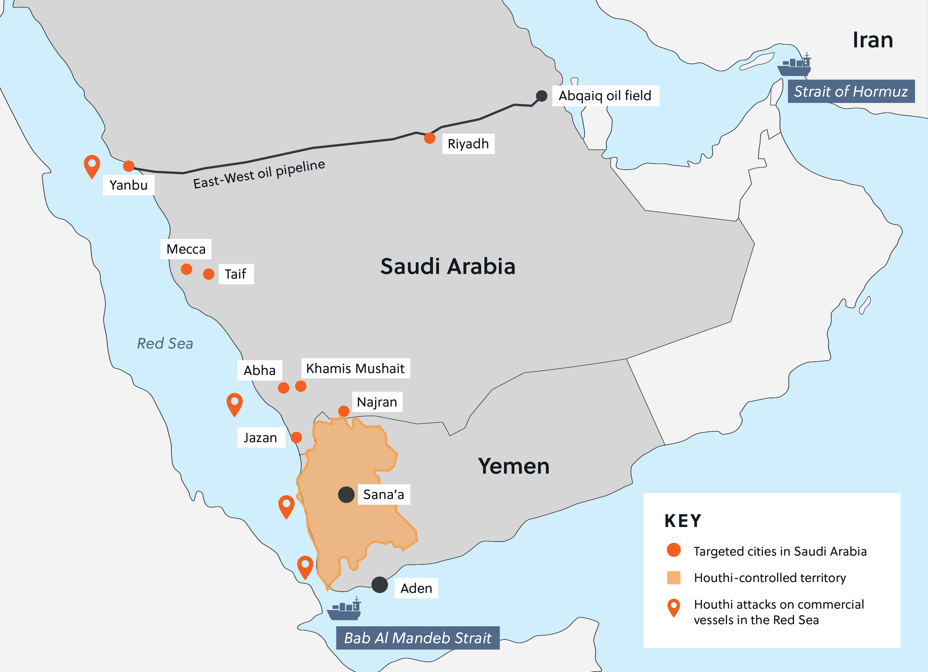
Yemen’s fragile truce has given way, sparking renewed conflict with consequences far beyond its frontlines. Within Yemen, heavy clashes have broken out along several frontiers between Houthi- and government-controlled territory, particularly in the Ma’rib, Ta’izz, and southern Al Hudaydah governorates, with hundreds killed on both sides. Some of the most intense fighting has taken place in Ta’izz, especially surrounding the port city of Mocha, highlighting competition for influence over the Bab Al Mandeb Strait in the Red Sea. Externally, Saudi Arabia – long the primary financial and military backer of Yemen’s official government – has also come under fire, with increasingly regular Houthi airstrikes targeting international airports in Riyadh, Dammam and other cities, energy infrastructure, military bases and cities along its southern border, and oil tankers travelling to and from its Red Sea ports.
These recent clashes mark the most significant escalation in Yemen’s civil war since the two sides agreed to a truce in April 2022. While that ceasefire lapsed six months later, back-channel negotiations between local and international stakeholders helped keep fighting at a low intensity; although, the parties failed to reach a lasting peace settlement. Now, four years later, hostilities have resumed, triggered by a Saudi-backed airstrike in July that targeted a runway at the Houthi-controlled Sana’a International Airport, preventing an Iranian plane from landing at the facility. In retaliation, the Houthis announced a maritime blockade against Saudi ships sailing through the Bab Al Mandeb Strait – in a similar vein to Iran’s blockade of the Strait of Hormuz – while heavy fighting resumed along several frontlines.
Saudi Arabia at the centre of a storm
Rising tensions in Yemen’s civil conflict are set to have direct security and commercial implications for Saudi Arabia, particularly its oil sector. Already under significant pressure from Iran’s blockade of the Strait of Hormuz since February 2026 – forcing Saudi Arabia to redirect about 75 percent of its oil exports from its eastern oil fields to its Red Sea ports via pipeline – the Houthis’ latest attacks have further interrupted production, refining, and export flows. The mid-September drone strike on the strategic East-West pipeline, for instance, halted oil flows for several weeks while repairs were underway, and earlier Houthi attacks also sparked fires and disrupted operations at a prominent oil refinery in Jazan. Given the past precedent for heavier and more damaging Houthi attacks against oil facilities in Saudi Arabia, including in 2019 and 2022, rising tensions with the Houthis have the potential to further destabilise the country’s energy sector over the coming months.
In addition, civilians and commercial operators in major cities – including Riyadh, Yanbu and Mecca – have faced repeated missile strikes and air raid evacuations. More than a dozen people have been killed and hundreds injured in recent attacks on Riyadh’s King Khalid International Airport, prompting the facility’s closure while multiple international airlines have halted all flights to the country. Safety risks to civilians are also pronounced in the southern border cities of Najran, Jazan, Abha, and Khamis Mushait, where dozens have been killed and injured in Houthi missile and drone attacks in recent weeks.
Notable locations in Yemen’s civil war, July-September 2026
Repercussions for global trade
More broadly, the Houthis advances in Yemen’s western coastal areas have, once again, highlighted the strategic importance of the Bab Al Mandeb Strait, another Middle Eastern chokepoint in global shipping. Since 2023, the Houthis have demonstrated both their intent and capabilities to target commercial shipping in the Red Sea and Gulf of Aden in support of their allies in Gaza, Lebanon, and Iran, and now for their own strategic interests in Yemen’s civil conflict. Increased Houthi influence over the strait would have significant trade repercussions, not only for Saudi Arabia, but also for goods moving between Asia and Europe, for which the Red Sea remains the fastest route. The Bab Al Mandeb Strait also accounts for an estimated five percent of global crude oil and refined petroleum trade – far lower than Hormuz’s 20 percent, but increasingly critical amid the latter’s intermittent closure – placing further upward pressure on already-high global fuel prices. Additionally, while the Houthis do not act solely in support of their financial and military backers in Iran – often balancing collaboration with their own domestic calculations – the Houthi’s control of Bab Al Mandeb would no doubt benefit Iran’s hand in the broader maritime competition with the US, closing some of the Gulf states’ options in circumventing the Iran-dominated Strait of Hormuz.
A remote prospect of de-escalation
A return to the previous status quo – where back-channel talks took place along frozen frontlines – is likely untenable amid wider regional tensions between the allies of Yemen’s warring sides (with Iran on one side, and the US and Saudi Arabia on the other), leading Yemen back to the brink of full-scale civil war. Domestically, too, both sides are motivated to fight; Saudi-backed government forces view this escalation as a threat to their authority and a potential opportunity to recapture territory, while for the Houthis, gaining fire power over the Bab Al Mandeb Strait would entrench their influence over Red Sea trade flows and exacerbate security risks and disruptions facing shipping operators throughout the broader Middle East region. One thing is certain, Yemen’s renewed civil war has the potential to redraw regional balances of power over the coming months, while the energy trade and shipping flows again bear the brunt of conflict in the Middle East.