
A recent spate of kidnappings targeting wealthy cryptocurrency businesspeople and social media influencers in France has raised concerns that this is less an isolated phenomenon, and more an emerging threat that faces the global crypto industry, writes Tamsin Hunt.
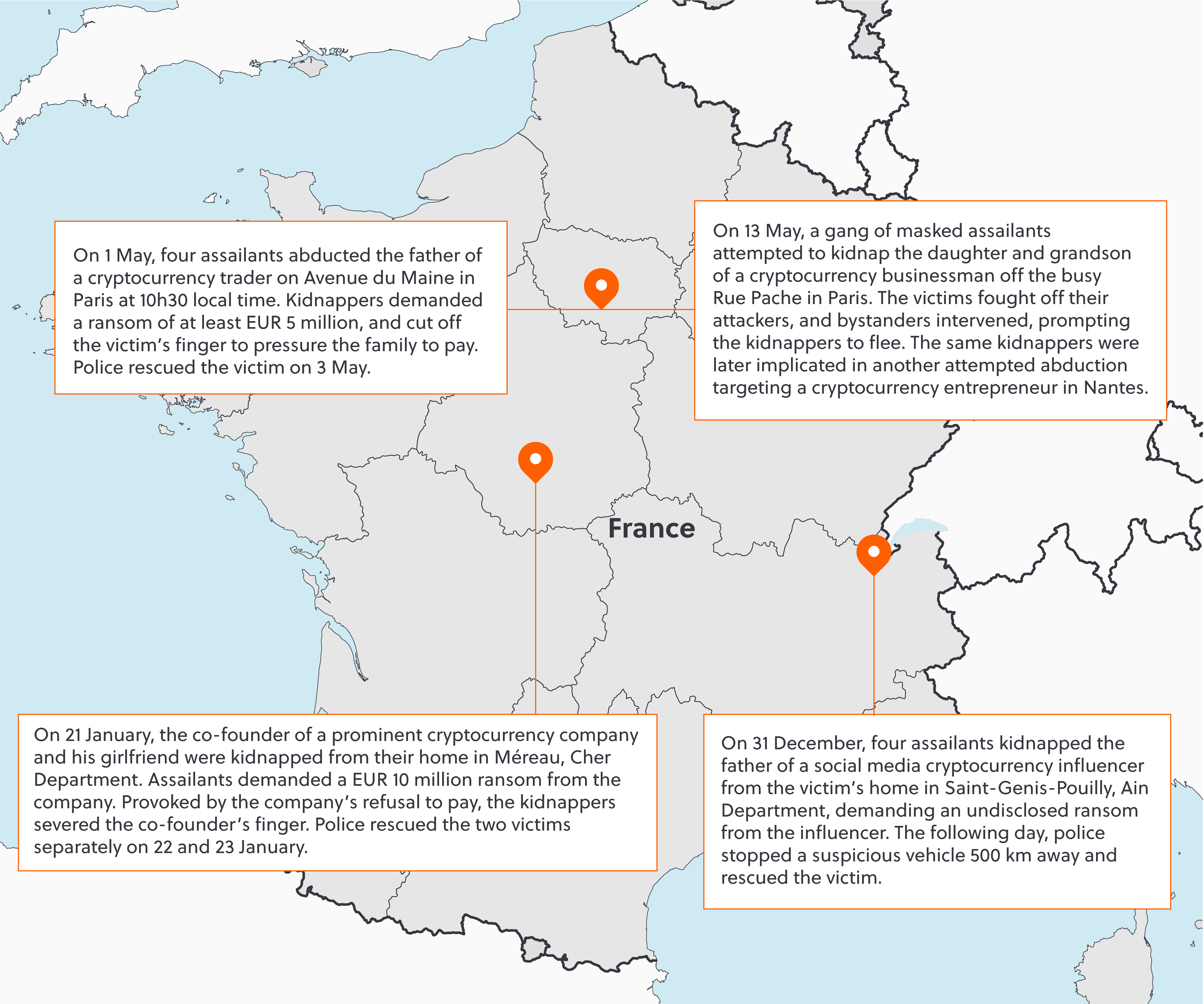
France has recently found itself the focus of a string of high-profile, sometimes violent kidnappings, all occurring within the past six months, and specifically targeting individuals involved in the cryptocurrency industry. Founders of particularly successful crypto investment companies, their families, as well as social media influencers have emerged as sought-after targets, with French police even offering home visits to industry leaders, security briefings, and priority access to emergency services. Meanwhile, the crypto sector’s fast-rising value, strong returns, and anonymous and unregulated transactions make it highly attractive to criminal enterprise in general. For France – one of Europe’s most crypto-friendly countries – the high concentration of well-performing crypto trading, investment, and banking companies has seemingly made it a natural target.
Kidnappings targeting crypto executives in France, January - May 2025
Law enforcement vs. transnational masterminds
French police have since clamped down on these kidnappings, arresting dozens linked to the latest attacks in late May and early June, and uncovering further details highlighting the organised and transnational nature of these activities. The most notable arrest came on 4 June, when Moroccan police in Tangiers arrested Franco-Moroccan national, Badiss Mohamed Amide Bajjou – one of two people suspected of orchestrating at least two of the four recent kidnappings in France. The emerging picture is one of cross-border criminal networks leveraging young, low-level local criminals to execute the actual kidnappings, while plots are often hatched and coordinated by criminals abroad, making it particularly difficult for authorities to trace or dismantle these complex webs.
Typical profile of a cryptocurrency kidnapping
 Targets
High profile cryptocurrency executives, traders, influencers, as well as family members and other individuals who may be leveraged to apply pressure to the intended victim.
 Perpetrators
Often low-level criminals, and youths between the ages of 16 and 25, paid to commit crimes by high-ranking criminals already in prison or based abroad.
 Ransom demands
Often exceeding USD 1 million.
 Associated violence
Kidnappers may use video of physical assault and torture as a means of pressuring the victim’s family or company, or torture to extract passwords to digital wallets.
 Global reach
Similar kidnappings have also been reported in the US, Australia, Canada and Belgium within the past year.
An emerging global trend?
Although these recent high-profile kidnappings in France have garnered significant media attention, this is not a trend that is limited to one country. In the US, for example, two local crypto businessmen held an Italian crypto millionaire hostage in New York City for several weeks in May, torturing the man to extract the password to his bitcoin wallet. Further (successful and unsuccessful) abductions have been reported in Belgium, Australia, Canada and Pakistan over the past year.
Wealthy victims’ information around their personal profiles, lavish lifestyles, and physical locations is often shared – intentionally or not – online, increasing their vulnerability. Crypto executives around the world are therefore taking extra precautions for themselves and their families; hiring personal security; limiting or delaying public exposure of geolocation tracking, travel itineraries, public event appearances and social gatherings; and deploying sophisticated and elaborate encryption methods for cryptocurrency passwords. These measures will likely make things difficult – but not impossible – for transnational threat actors engaging in this fast-growing criminal revenue generator in the coming months. But criminal groups have also displayed significant adaptability, and a readiness to leverage new and rapidly advancing technology in their cross-border activities, making it increasingly difficult for authorities – and potential victims – to fully secure against an attack.