
In the first half of 2026, at least nine Somali piracy attacks were reported around the Horn of Africa, marking a significant increase compared to recent years. Tamsin Hunt examines the conditions that have facilitated the recent surge in attacks.
A recent string of piracy attacks around the Horn of Africa has revived fears of a resurgence in Somali piracy. Since the start of 2026, at least nine incidents have been reported along or close to the coast of Somalia, including four successful hijackings – two oil tankers, one cargo carrier, and a small dhow – two attempted boardings, and three shooting exchanges between vessels and suspected pirates. Of the four vessels captured, three remain in the hands of pirates, anchored close to the shore, with ransom demands reaching as high as USD 10 million.
Somali pirate attacks in the first half of 2026
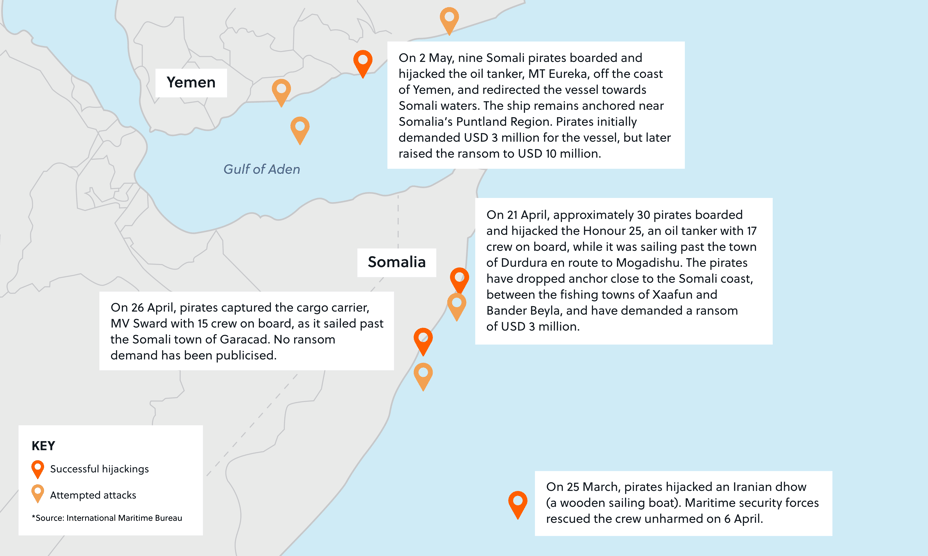
Compared to the height of Somali piracy between 2005 and 2011, the number of hijackings has diminished to just a handful of successful incidents per year, but the systemic issues that drove the surge of attacks in the past still broadly exist today. Somalia’s political environment has long been characterised by deep instability and recurring power struggles between the federal government and regionally powerful clans, divisions that have deepened as the government attempted to consolidate power over the last few years. In the past, some prominent clans and political elites – particularly the Majerteen clan in northeastern Puntland State – turned to piracy to help fund political campaigns and military advancements, underpinning the 2005-2011 surge in Somali piracy. Additionally, poverty is endemic in Somalia, a situation recently exacerbated by droughts and other adverse weather events, rising food and fuel costs stemming from conflict in the Middle East, and the sharp drop in international humanitarian aid, which almost halved from 2024 to 2025. Rising unemployment, inflation, and food insecurity have the potential to motivate many to turn to high-risk, high-reward criminal enterprises like piracy.
Somali piracy at its peak: 2005 – 2011
 Somali piracy began to increase from 2005. At its height between 2009 and 2011, more than 200 incidents were reported annually off the coast of Somalia and neighbouring maritime territories, accounting for more than 50 percent of all piracy attacks globally.
 Hundreds of crew members were taken hostage, with the average length of captivity stretching more than eight months.
 On average, ship owners paid USD 3 million to recover their ships, cargo and crew. However, individual ransom amounts could vary widely, from hundreds of thousands to more than USD 10 million.
 In response, about 35 navy fleets assisted in patrols of the region, costing more than USD 1 billion annually. As a result, the hijacking success rate dropped significantly from 2008, and the frequency of attempted attacks diminished from 2012 onwards.
Source: World Bank
New opportunities
Adding to domestic fragility, developments in the wider Middle East region in recent years have prompted the diversion of anti-piracy navy fleets to volatile waters elsewhere. In late 2023, some international anti-piracy patrols reportedly moved to secure the Red Sea in response to Houthi attacks on maritime traffic, and while details around the precise movements of Western navies have been scant amid the US-Iran War in early 2026, it is plausible that at least some anti-piracy resources have been redirected to support the military buildup along Iran’s coast and the Strait of Hormuz. Furthermore, under threat of attack in both the Red Sea and Persian Gulf, many ship operators have elected to detour around the Cape of Good Hope, increasing ship volumes sailing through or close to Somali waters. Heavier traffic volumes, alongside reduced maritime security, have created opportune conditions for Somali pirates operating in the eastern Indian Ocean.
More concerning still, the strengthening networks of cooperation between criminal pirate groups, Yemen-based Houthis, and Al Shabaab – an Al Qaeda-affiliate that now controls vast parts of central and southern Somalia – have improved pirate capabilities. Through expanded collaboration between these three parties, pirates have received training, weapons, and GPS technology that enables the accurate tracking of their targets. Meanwhile, Al Shabaab receives a cut of the ransom proceeds from pirates operating in their territory, and both Al Shabaab and the Houthis have leveraged pirate smuggling routes for a broader black-market arms trade between Yemen and Somalia. Moreover, pirates have historically prioritised ransoms over cargo theft, lacking the requisite infrastructure and markets to sell goods on, but new connections with well-established organisations like the Houthis and Al Shabaab could present new opportunities for maritime crime over the longer term.
Rough seas ahead
From mid-June, monsoon rains and rough seas will dampen the appetite for piracy, and incidents will likely diminish. But the underlying conditions – both onshore and offshore – that have facilitated recent hijackings are unlikely to change in the immediate term, and come September, calmer waters will likely bring another resurgence. In 2010, piracy cost the world USD 18 billion in lost revenue and higher shipping costs, with the World Bank describing it as a “tax on world trade.” While we remain far from returning to that kind of scale, shipping operators will surely be considering the added cost pressure of security measures, ransoms, and lengthy diversionary journeys over the coming months.