As increased polarisation and public dissatisfaction around a range of policy issues drive political tensions ahead of the November 2026 midterm elections, Richard Gardiner examines factors likely to influence unrest and disruption across the United States (US) in the coming year.
On 18 October, an estimated seven million protesters took to the streets in the US as part of the ‘No Kings’ protest movement – one of the largest single-day demonstrations in US history – to express opposition to the administration of President Donald Trump. In recent months, US opposition groups have mobilised in response to federal priorities and ongoing disputes over the administration’s enforcement of its immigration agenda, the economic impacts of a 44-day government shutdown, partisan deadlock over healthcare policy, and differing views on election integrity ahead of the upcoming 2026 midterms. In addition, alleged links between Trump and the late convicted sex offender Jeffrey Epstein have drawn intense public interest, and on 18 November, both chambers of Congress overwhelmingly voted to compel the release of all federal investigative files pertaining to Epstein following bipartisan calls for further disclosure.
Amid these developments, some media polls — including Reuters, CNN, and the Associated Press — now place President Trump’s approval rating below 40 percent. As his ratings have declined, and grievances around key issues have deepened, protests pose a growing risk of disruption across the US, as well as a heightened potential for confrontations between demonstrators and law enforcement. As national debates intensify entering the election year, three main dynamics are likely to drive unrest in 2026: the affordability crisis, tensions around federal operations, and intensifying political polarisation.
President Trump’s declining approval
President Trump won a clear victory in the 2024 presidential election, flipping six states that voted for Democrat Joe Biden in 2020 and winning the national popular vote with a 1.5 percent plurality, making him the first Republican to win the popular vote since 2004. The Republican Party also maintained control of the Senate and the House of Representatives. The outcome of the elections likely reflects the impact of the post-pandemic surge in inflation, Trump’s gains among working-class and minority voters, and Biden’s low approval ratings. However, there are indications that Trump’s political standing has significantly eroded since his inauguration. On 4 November, Democrats swept a series of off-year election contests in blue states, winning gubernatorial elections in New Jersey and Virginia, a mayoral election in New York City, and a California redistricting referendum. More significantly, Democrats also won a series of lower-profile contests in states Trump won in 2024, including flipping state-level seats in Georgia, overturning the Republican legislative supermajority in Mississippi, and electing three Democratic candidates to the Pennsylvania Supreme Court.
An affordability crisis
Recent polling suggests that public views of the economy are closely tied to President Trump’s approval ratings. A Fox News poll released in mid-November showed that 76 percent of respondents view the economy negatively under Trump, up from 67 percent in July and above the 70 percent negative rating under President Biden. Polling by the Pew Research Center in October shows mixed views among voters regarding the administration’s economic performance: around half of registered voters say Trump’s economic policies have negatively impacted economic conditions, while 56 percent of Americans disapprove of his flagship tariffs policy according to an October CNBC poll, which some observers argue is weighing on the broader economy. Trump has pledged to correct course, arguing that inflation is “almost at the sweet spot,” and his administration is exploring measures to lower the cost of living, including tariff rebate payments and the possible backing of 50 year mortgages to make housing more affordable.
Nevertheless, economic concerns have been central to recent demonstrations. In April, opponents of the administration’s ‘Big, Beautiful Bill,’ presented as a major economic reform package, held 'Hands Off' protests across the country, while Labour Day rallies in September under the 'Workers Over Billionaires' banner denounced cuts to education, healthcare, and welfare spending, as well as rising income inequality. Should public perceptions around the US’s economic health – and the associated impact to households – deteriorate, sustained unrest over economic issues is likely to extend well into 2026.
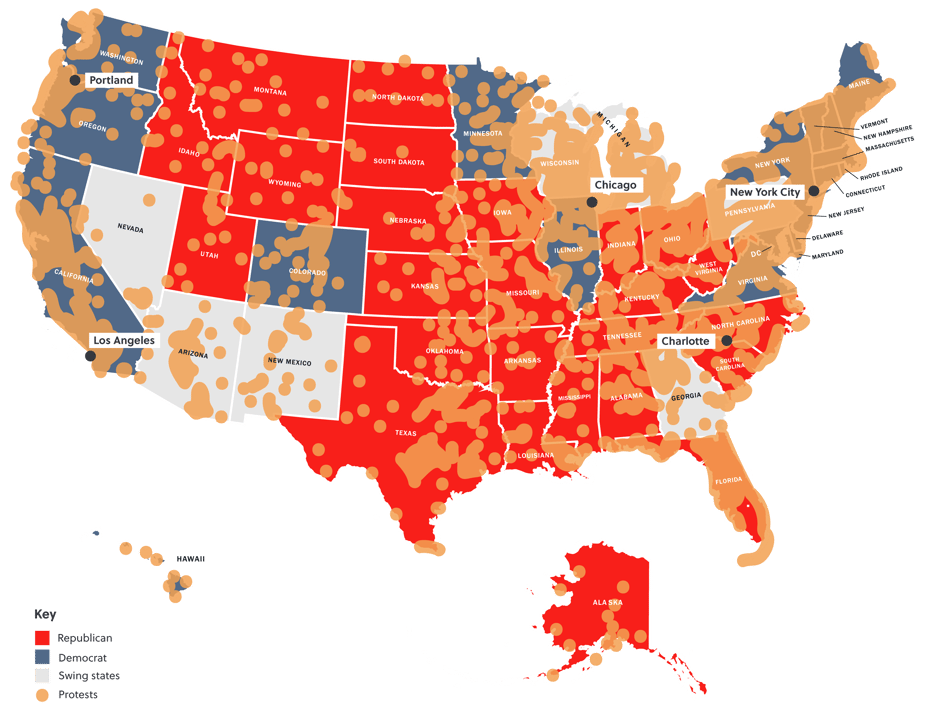
Anti-government protests in the US in November 2025
 Source: Armed Conflict Location & Event Data (ACLED)
Tensions around federal operations
Federal immigration enforcement has emerged as a potential flashpoint for protest violence. With federal authorities pursuing “record-breaking immigration enforcement,” there have been increased deployments of federal agents to ‘sanctuary’ cities including Los Angeles, Chicago and Portland, as well as other urban areas with large immigrant populations, often despite opposition from local officials. This has prompted community backlash and demonstrations, some of which have turned violent. In Los Angeles, protests escalated in June after Immigration and Customs Enforcement (ICE) conducted a series of raids, leading to clashes between activists and police, as well as solidarity demonstrations countrywide. In Chicago, activists and local authorities have accused ICE of using increasingly violent and escalatory tactics, including deploying chemical irritants as part of crowd control tactics. The administration has pledged to expand its enforcement activity to other locations – most recently deploying to Charlotte, North Carolina – driving the risk of further disruptions and escalation.
Intensifying polarisation
The threat of violent unrest, as well as politically motivated violence, also persists ahead of the elections, fuelled by growing polarisation, declining trust in institutions, and the amplification of views and grievances in online echo chambers. Recent incidents, including the June killing of Minnesota state legislator Melissa Hortman, a Democrat, the September shooting of conservative activist Charlie Kirk, and reported threats against Republican Congresswoman Marjorie Taylor Greene in November, have drawn attention to the risk of social instability and targeted violence ahead of the midterms.
With recent midterm polling showing Democrats with a wide lead, activists and officials have accused Trump of planning to interfere in the vote. In March, Trump issued an executive order expanding voter registration requirements, which was later blocked in court, and has also called for eliminating mail-in ballots and banning voting machines, with his administration claiming that these measures are necessary to prevent fraud and ensure election integrity. Opponents have argued that they will reduce voter access and unfairly advantage Republican areas. At the same time, partisan tensions have been stoked by a series of redistricting efforts, in which Republican and Democratic states like Texas and California have engaged in tit-for-tat redrawing of their congressional maps to benefit their preferred party. Later this year, the US Supreme Court – widely considered to be facing a crisis of public legitimacy – will rule on high-profile cases involving the Voting Rights Act of 1965 (preventing racial discrimination in voting) and absentee ballot measures, potentially presenting a flashpoint for further polarisation. With both parties engaging in escalating rhetoric, this could further inflame tensions ahead of the elections.