Coordinated armed attacks by armed groups have increased in Colombia in recent months, despite attempts (and some successes) by the government to negotiate and demobilise them. Tamsin Hunt considers how Colombia’s evolving security landscape will test the incoming administration.
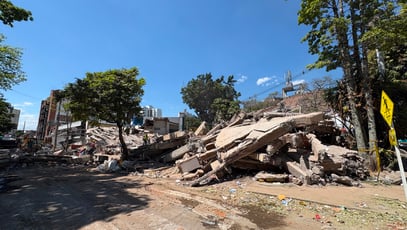
The first six months of 2026 have seen a notable rise in coordinated attacks by armed groups against a range of targets, from security personnel and political leadership to critical infrastructure. In April 2026, a bomb struck a passenger bus on the Pan-American Highway, killing 21 people. Later claimed by a Fuerzas Armadas Revolucionarias de Colombia (FARC) faction, this incident marked the deadliest attack in Colombia since 2003, despite FARC’s insistence that it had meant to target a military vehicle rather than civilians. This bombing has underscored the deepening security crisis in Colombia as successive administrations have struggled to contain group fragmentation and rivalries.
The last two administrations have tried vastly different strategies, ranging from former President Iván Duque’s (2018 – 2022) prioritisation of the military in capture-or-kill operations and the eradication of coca plantations, to outgoing President Gustavo Petro’s efforts to negotiate with dozens of fragmented groups under a ‘Total Peace’ plan. Neither approach has seen substantial improvements in the security environment, with several ceasefires secured early in Petro’s administration collapsing in the face of unchecked violence. The new administration, led by Abelardo de la Espriella, promises a return to a militarised strategy to deal with the growing security crisis, but several obstacles are likely to frustrate government efforts over the coming year.
Armed violence in Colombia
Attacks that resulted in three or more fatalities
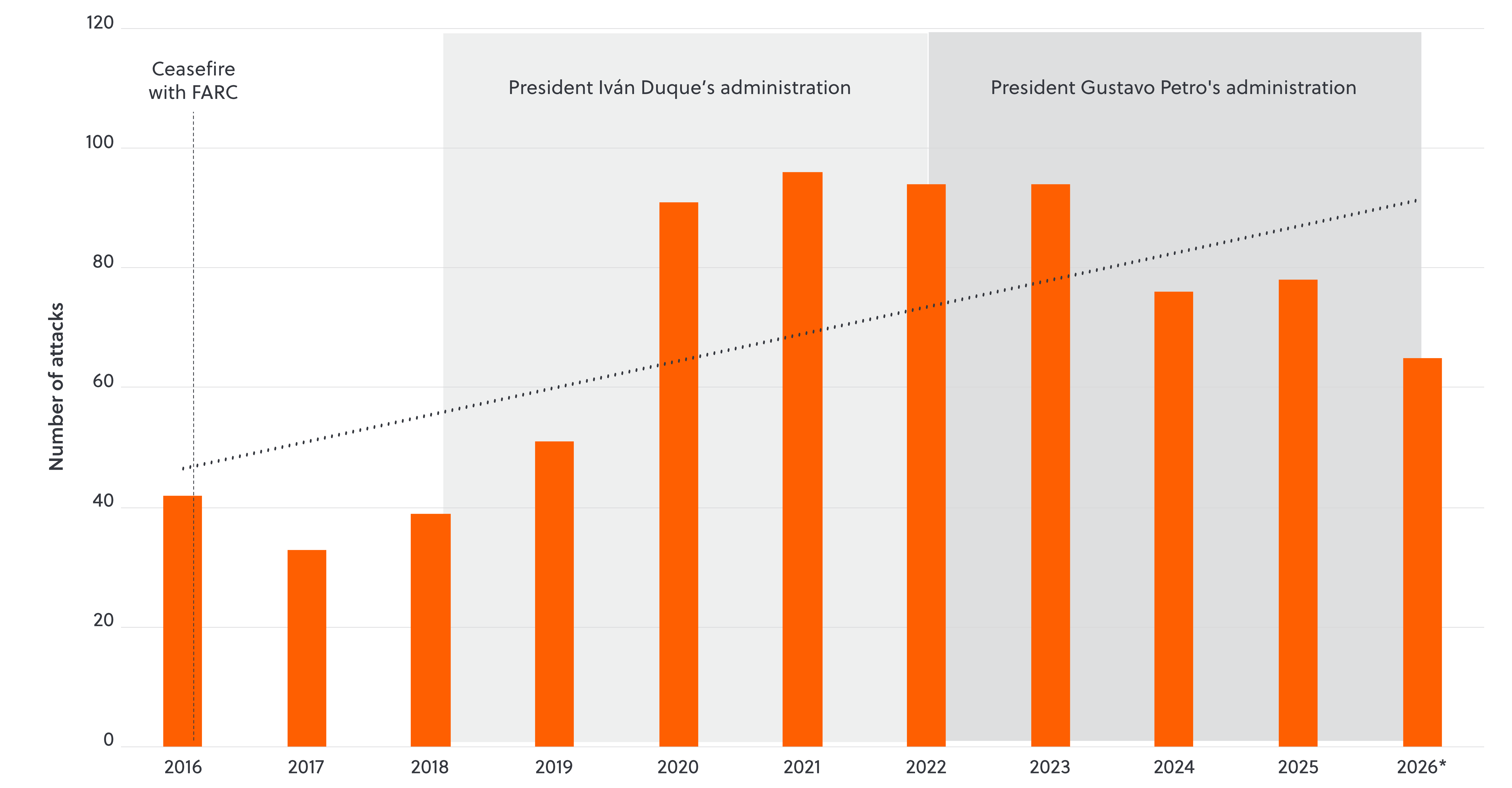
*First six months of 2026
Source: Indepaz, a local NGO, human rights monitoring platform, and conflict observatory
Splintering and diversifying
Following a landmark peace agreement with FARC which ended the country’s civil conflict in 2016, some factions refused to disarm. Power vacuums in cocaine-producing corridors previously dominated by the group contributed to an ongoing fragmented patchwork of armed groups, including FARC dissidents and the Ejército de Liberación Nacional (ELN). Multiple groups continue to vie for territorial control over various illicit economies like drug trafficking, illegal mining, kidnapping, and extortion against the mining, transport and agriculture sectors, and across several departments like Chocó, Antioquia, Valle del Cauca and Nariño, frustrating efforts to tackle their activities in a uniform manner.
Fragmentation has also made these groups particularly difficult to address under Petro’s strategy: there is often no single chain of command with which to negotiate, factions – even within the same umbrella group – have differing agendas and demands. The attractiveness of illicit revenue, and uncertainty regarding the outcome for groups who decide to disarm and demobilise, remain strong incentives to reject or defect from talks, and will drive persistent risk of violence. While the ELN, for example, has indicated willingness to negotiate with the new government, it has warned that it can withstand any military crackdown and is ready for confrontation.
Growing capabilities
Groups’ ability to adapt through new tactics and technologies has at times outpaced security strategies, allowing them to withstand military pressure and maintain leverage in negotiations. For example, almost all major groups, including FARC and the ELN, have adopted the use of cheap commercial drone technology – widely available online – adapting them to carry explosives and conduct surveillance. The proliferation of affordable and modifiable drones have enabled criminal groups to operate from a distance, and army units – lacking the requisite anti-drone equipment – have been overwhelmed by swarm attacks. The country recorded more than 300 successful drone attacks in 2025, and in a speech to the military in December 2025, President Gustavo Petro announced that “drug traffickers have the air advantage.”
Local embeddedness
A weak state presence in several areas – especially in remote regions – has allowed armed groups to fill governance gaps, recruit, and regenerate after short-lived police or military campaigns. As these groups expand criminal activity and territorial control, they have increasingly imposed their own rules on local communities and power structures, restricting and monitoring mobility through a system of identification cards, checkpoints and curfews, and coercing residents to vote for preferred electoral candidates. In severe cases, entry is barred even to police and military personnel, and anyone perceived as a threat to these de facto regimes face harassment, violence, and displacement from their homes.
This embeddedness makes armed groups difficult to dislodge; communities often comply out of fear or dependence, intelligence is hard to obtain due to fear of reprisal violence against perceived informants, and when security forces successfully enter an area, they often struggle to assert continued control.
Structural and enforcement challenges
Over the last 10 years, challenges in addressing organised crime and violence have been complicated by structural dynamics that have created a broadly permissive environment for criminal activity. Embedded corruption and institutional weakness has blunted security enforcement and legal processes, and undermined community trust in authorities, while security forces face underinvestment driving resourcing and capacity constraints. Meanwhile, poor socio-economic conditions – particularly in remote rural areas – has made criminal activity attractive to many amid bureaucratic delays in improving employment to reduce poverty.
The government’s ability to improve the security situation under the incoming administration will depend on addressing not only challenges of splintering, adaptation and local governance infiltration among armed groups, but also these deeper structural issues. In the meantime, Colombian communities and commercial operators in affected areas will have to contend with the daily realities of persistent violence, armed governance, and recurrent displacement.