
Cyber threats are not simply becoming more sophisticated. They are becoming faster, more scalable and increasingly focused on the systems and data that give attackers the greatest leverage.
In this article, we share the key insights from S-RM’s mid-year cyber threats update. Drawing on incident response data from the first half of 2026, Casey O'Brien, Joani Green, Dan Caplin along with special guest, Stuart Seymour from Virgin Media O2, examined how ransomware and other attack types are evolving, and where artificial intelligence is beginning to change the threat landscape. Their conclusion was clear: AI is giving attackers new capabilities, but organisations’ most immediate risks still come from familiar weaknesses in identity, cloud configuration, software supply chains and incident preparedness.
Watch the full discussion here
Ransomware remains prominent, but the incident mix is changing
Ransomware accounted for approximately 34% of the incidents handled by the S-RM IR team in the first half of 2026. It remained the largest individual category, although its share was around 10% lower than in 2025 (see figure 1). This does not necessarily indicate that ransomware activity has declined overall. Instead, ransomware now represents a smaller proportion of a broader and increasingly varied incident landscape.
Meanwhile, network intrusions, web application compromises and cloud compromises all increased as a share of incidents. Web compromises typically followed a familiar pattern: attackers inserted malicious code into websites to steal personal information or payment card details. The resurgence of these attacks may reflect the growth of e-commerce functionality among smaller businesses, increasing numbers of disclosed vulnerabilities and attackers’ ability to find and exploit weaknesses more efficiently.
Total incidents by type
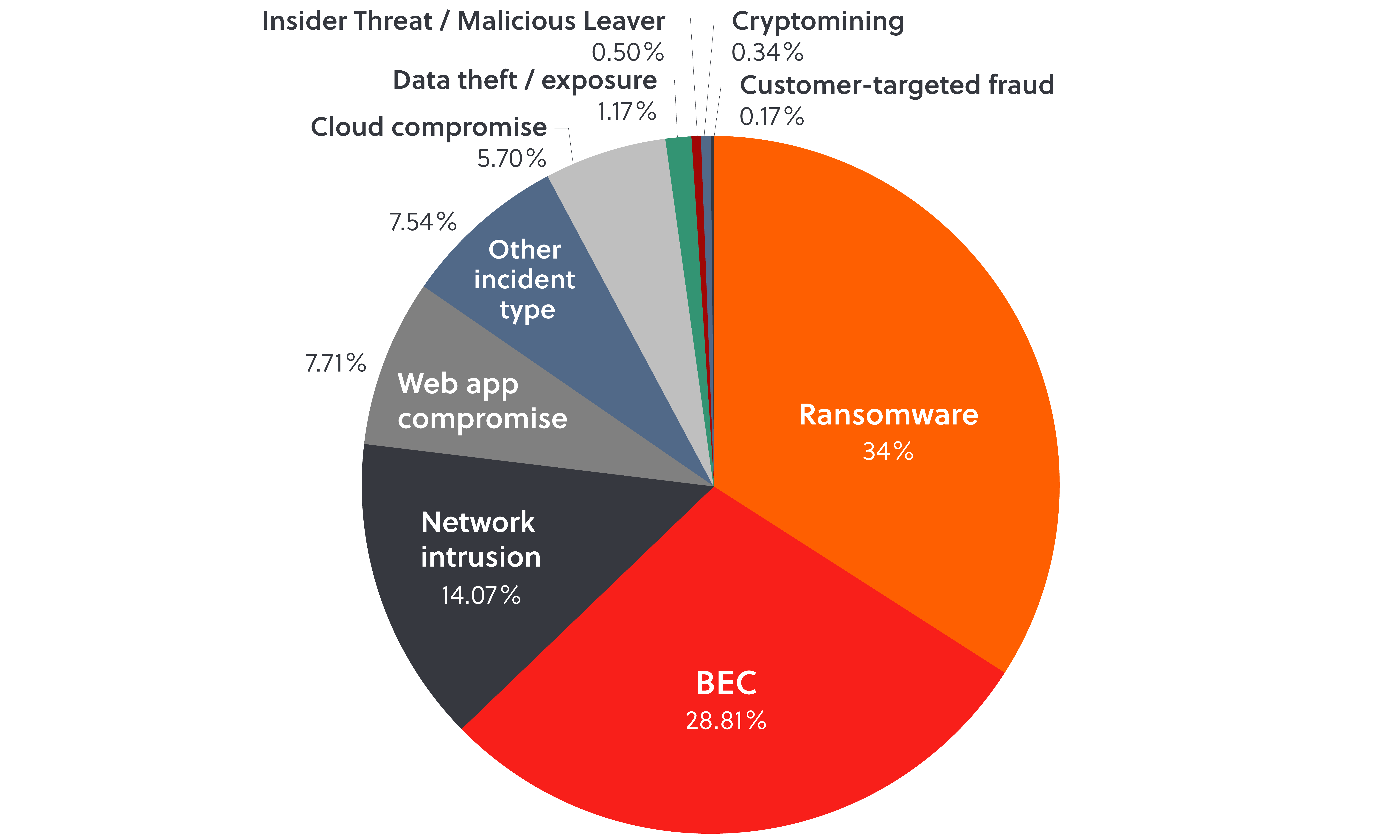
Cloud incidents were more varied. In some cases, an attacker compromised a user identity that provided access to several downstream cloud platforms. In others, the entry point was a vulnerable cloud-native service, an exposed application programming interface or misconfigured storage such as an Amazon S3 bucket. We also saw attackers gain access to cloud administration environments and used victims’ computing resources for activities such as cryptomining.
Unlike traditional ransomware incidents, these compromises did not generally result in widespread encryption or prolonged system downtime. The more common goal was to obtain data or computing resources while bypassing endpoint monitoring on laptops and servers.
Cloud adoption is continuing to expand, including among small and medium sized organisations (SMEs). At the same time, threat actors are modernising their methods. Directly targeting cloud services, identities and administrative environments can allow them to reach sensitive data without first compromising a conventional endpoint.
Threat actors are modernising. They’re seeing cloud-focused attacks as ways to get around endpoint security monitoring.”
Dan Caplin
Software supply chains are an increasingly attractive route into organisations
Attackers are also targeting the systems used to develop and distribute software. These incidents can begin with a compromised code repository, build pipeline or trusted third-party package. By stealing tokens, source code or developer credentials, an attacker may gain access to multiple cloud environments or introduce malicious code into software used by downstream organisations.
The opportunity is particularly attractive because software updates and packages are expected to be trusted. If an upstream component is compromised, malicious code may pass through controls that would stop a more conventional intrusion.
This risk is being amplified by AI-assisted software development. In two investigations, developers used AI tools to accelerate the creation of website code. The generated code drew on compromised packages from open-source repositories. When those packages ran on developers’ workstations, they installed credential-stealing malware linked to a North Korean state-backed campaign. The resulting incident exposed secrets held in both source code and cloud environments.
Professional developers can struggle to identify a malicious dependency hidden within AI-generated code. Less experienced “citizen developers” may be even less equipped to recognise insecure or compromised components unless effective review and software development controls are in place.
Ransomware is becoming data-first extortion
The ransomware model itself is also changing. Instead of spending time encrypting an organisation’s systems, some attackers are moving directly to sensitive data and using the threat of publication as their principal source of leverage.
This approach reduces attackers’ cost and effort. It also allows them to target more organisations while avoiding some of the operational complexity involved in deploying encryption across a network.
They’re going directly to sensitive data and then using that for extortion. It gets them to their objective sooner.”
Joani Green
S-RM’s incident response data suggests that less than a quarter of ransomware victims now pay. Where organisations do pay, the main motivation is increasingly to prevent the publication of stolen information rather than to obtain a decryptor.
Attackers are also examining stolen data more carefully. Rather than making a generic claim that they possess a certain volume of files, they identify the records most likely to cause regulatory, commercial or reputational harm. AI can make this process faster by combining information from separate databases and producing coherent reports on individuals, customers or business activities.
Some groups have begun threatening to automate direct contact with the people whose information has been stolen. AI could allow an attacker to extract customer contact details, assemble personalised data packages and conduct outreach at a scale that would previously have required significant manual effort.
Identity has become a gateway to the whole cloud environment
Several active threat groups continue to succeed without fundamentally changing their methods. Unsecured virtual private networks, unpatched vulnerabilities and single-factor remote access remain effective entry points. Attackers also use legitimate IT support tools to maintain access and target infrastructure such as hypervisors to avoid endpoint detection systems.
At the same time, newer groups are placing greater emphasis on identity. A single compromised account within a central identity provider such as Okta or Microsoft Entra may provide single sign-on access to Microsoft 365, Salesforce, Box, Workday and other services.
From that point, the attacker can move rapidly across cloud applications, access large volumes of information and extort the organisation without deploying malware or encrypting devices.
This makes identity security one of the most important defensive priorities. Phishing-resistant multifactor authentication, strong controls for privileged accounts, trusted-device requirements and least-privilege access can prevent one stolen credential from becoming an organisation-wide compromise.
How attackers are using AI today
The most visible impact of AI is not yet autonomous hacking. It is the improvement and acceleration of existing techniques.
In voice phishing attacks, AI-generated scripts can help callers respond more fluently and adapt their approach during a conversation. In business email compromise, attackers who enter a genuine payment conversation can imitate its language and style more convincingly. The initial phishing message may still be generic, but communications sent after the mailbox has been compromised are becoming more personalised and difficult to distinguish from legitimate correspondence.
AI is also helping threat actors analyse stolen information, identify damaging records and construct more persuasive extortion demands. Several newer groups encountered during 2026 were already providing victims with AI-generated reports that connected data from different parts of a stolen dataset.
Emerging risks: adaptive malware and LLM jacking
Fully AI-generated malware is not yet operating at scale. Some samples appear to have been created with AI, but their technical quality has often been limited. More concerning are early examples of malware that uses a large language model while it is running.
Instead of carrying a fixed set of commands that security tools may recognise, this malware can query a model to generate commands or modify its behaviour. Its objective may be familiar, but its implementation can change according to the environment, making signature-based detection more difficult.
Another emerging threat is “LLM jacking”. Similar to cryptojacking, this involves stealing AI credentials, tokens or computing resources and using or reselling them. One organisation we supported through a response received a bill of approximately USD 500,000 over three days after an AI token was stolen through a vulnerability in an exposed application.
Compromised AI infrastructure may also be incorporated into wider offensive frameworks, providing attackers with a reasoning engine to support other stages of an attack.
The next frontier is scale, speed and persistence
AI models and agent frameworks increasingly have the capability to identify vulnerabilities, connect offensive security tools and attempt exploitation with limited human involvement. An attacker no longer necessarily needs access to a restricted frontier model. A capable open-source model, an agent framework and established security tools may be enough to automate parts of the process locally, beyond the visibility and safeguards of model providers.
The immediate danger is not that every AI agent will devise an unprecedented attack. It is that large numbers of agents can test weaknesses persistently and at machine speed.
What we’re up against is scale and persistence.”
Stuart Seymour
This could increase the frequency of attacks while reducing the time between initial access, data theft and operational impact. Organisations may therefore have less time to determine whether an alert is genuine before an attacker reaches critical systems.
Defending against AI-enabled threats starts with the fundamentals
The panellists’ recommendations did not begin with acquiring a new AI security product. They began with defence in depth:
- Use phishing-resistant multifactor authentication for privileged and high-value accounts.
- Restrict access according to the principle of least privilege, including for AI agents.
- Require trusted and compliant devices for access to critical systems.
- Maintain secure software development and dependency-review practices.
- Continuously monitor the external attack surface.
- Segment networks and critical environments.
- Modernise social engineering exercises to include realistic voice phishing and targeted attacks on executives, IT, finance and HR.
- Review technical response playbooks and consider when it may be safer to lock down access before completing an investigation.
AI can also strengthen defence. It can help security teams examine logs, identify patterns and process data during an incident. The challenge is to use those capabilities without treating AI as deterministic or granting agents unnecessary access.
Incident preparation is equally important. Organisations should agree their approach to ransomware before an attack occurs, establish response retainers and determine the sequence in which essential capabilities would be restored. Recovery priorities should reflect technical dependencies, such as identity and network access, rather than simply starting with the most visible business application.
AI changes the pace, not the principles
AI is giving attackers better language, faster analysis and the ability to automate activity at greater scale. It is also introducing new exposures through coding tools, agent identities and poorly protected AI infrastructure.
Yet the incidents responded to by S-RM so far in 2026 show that many successful attacks still depend on familiar weaknesses: exposed remote access, compromised identities, insecure software dependencies, cloud misconfiguration and slow response.
For security leaders, the priority is not to predict every possible use of AI. It is to build an organisation that can withstand more frequent attacks, detect activity quickly and act decisively as the time available to respond continues to shrink.
If you would like to speak to one of our experts, please contact us here.