Now in its third consecutive year of civil war, Sudan’s formal economy has effectively collapsed, resulting in a war economy that is heavily reliant on the exportation of gold, particularly to the Gulf. In this piece, Osob Dahir reflects on the challenges for existing impact investors - whether DFIs, angel investors, or multinational corporations - of navigating this complex terrain through examining the evolution of the sanctions landscape, opportunities presented by collaborating with local communities, and the importance of considering sectors that are strategic to the long-term goals of influential Gulf actors.
It has been four months since the UK government hosted the Sudan conference on 15 April 2025, which brought together a broad delegation of foreign ministers and high-level representatives from several countries – excluding Sudan – to address the ongoing crisis, but there has been little by way of initiative led by the international community to bring an end to the country’s two year long civil war. The war, which began in April 2023, has primarily been fought between the Sudanese Armed Forces (‘SAF’), led by Abdulfattah Al Burhan (‘Al Burhan’), and the Rapid Support Forces (‘RSF’), led by Mohamed Hamdan Dagalo (more commonly known as ‘Hemedti’). Despite recent gains by the SAF, particularly following its full re-capture of Khartoum at the end of May, a conclusion to the war is not on the horizon, with Abdulla Hamdouk (‘Hamdouk’), the former prime minister of Sudan, acknowledging in June 2025 that a military victory to end the war would be unlikely.
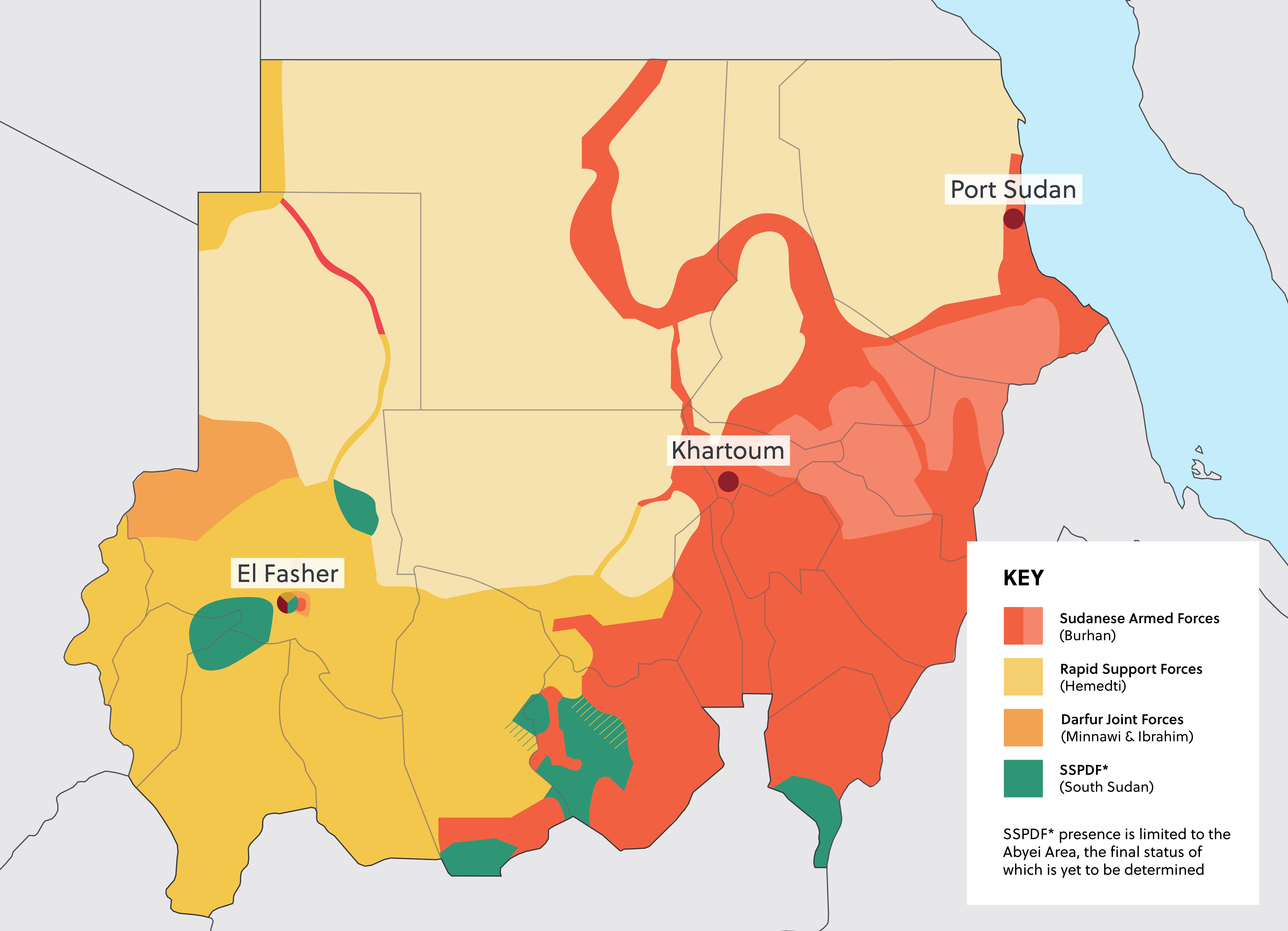 Figure 1: Sudan’s shifting frontlines as at 1 August 2025 (Source: Thomas van Linge)
The slide of Sudan’s economy
Now in a third consecutive year of civil war, Sudan’s formal economy has effectively collapsed, largely due to devastating paralysis in productive sectors, mainly in agriculture, and high levels of inflation particularly for basic commodities. In August 2024, the Minister of Finance, Gibril Ibrahim, reported that the economy shrank by 28 percent, compared with a 40 percent decline reported the previous year when the war first began. The emerging war economy has seen an increased dependence on the production, smuggling, and exportation of the mineral sector – mainly gold to the Gulf – which is extracted from both SAF- and RSF-controlled territories. This backdrop presents a moment to reflect on key considerations for existing investors in Sudan, whether impact investors such as development finance institutions, angel investors focused on start-ups, or multinational corporations. Investors must be able to perform a delicate balancing act of navigating acute risks inherent in operating in a war economy, which places the well-being of Sudanese people at the heart of commercial activities, alongside the need to develop a long-term strategy aimed at maximising returns. Central to this is limiting exposure to the extensive international sanctions regimes against Sudan and related human rights concerns, while diversifying provisions of goods and services, and, finally, considering key growth sectors that are also deemed strategic to the long-term goals of influential Gulf actors.
Understanding the evolving sanctions landscape
Sudan’s sanctions landscape should be a priority consideration for existing international investors in-country. During the 1990s, Sudan was subject to blanket sanctions, principally by the US government, targeting the Omar Al Bashir regime’s alleged support of jihadist groups, as well as human rights abuses at home. The contemporary sanctions landscape, while still ostensibly focused on restoring peace and stability, is more diverse and ranges from very targeted to more general sanctions. For example, the UK and EU’s designations since 2023 appear to be more limited and deliberate in targeting financial flows that have perpetuated the war on both sides. On the other hand, the US has gone further and appears to have taken a more direct approach to sanctions by being the first – and until March 2025, the only country –to sanction both Burhan and Hemedti, right at the close of the Biden administration in January 2025. In May 2025, the new US administration under President Donald Trump followed this up by imposing restrictions on exports to Sudan and access to US lines of credit over the SAF’s alleged use of chemical weapons.
Existing foreign investors in Sudan are mitigating or eliminating exposure to sanctions by reviewing commercial relationships with local partners and their supply chains.’’
Given the fluid nature of the war, the sanctions landscape is set to evolve under the current US administration. Despite initial perceptions that the Trump administration would take an isolationist approach to foreign policy, and especially Africa, President Trump has sought to shape the evolution of conflicts in the Middle East, whether in the war between Israel and Iran, or in attempting to influence the terms of a ceasefire in Gaza. Nonetheless, the May 2025 announcement may provide an insight into how Gulf interests in the ongoing war could influence US interests in Sudan. Both Saudi Arabia and the UAE have reportedly pledged hundreds of billions of dollars in US investment in 2025, while the Gulf region was President Trump’s first foreign visit in his second administration. This will likely translate to some form of leverage for Gulf influence in US foreign policy, whether in Sudan’s sanctions landscape, or the broader Middle East. Indeed, at the end of July 2025, it was reported that the US administration was pivoting to address peacekeeping efforts in Sudan by hosting representatives from Egypt, the UAE, and Saudi Arabia.
Within this context, existing foreign investors in Sudan are mitigating or eliminating exposure to sanctions by reviewing commercial relationships with local partners and their supply chains, which is critical in determining whether they belong to networks that include designated groups, or commercial entities likely controlled by designated individuals. Human rights groups have condemned both the SAF and the RSF for gross abuses over the course of the war, but particularly the latter for some of the most severe and targeted violence, and the proportion of this is perhaps reflected in the skew in the number of major designations against the RSF.
Commercial opportunities through serving local communities
Despite the challenging commercial landscape in Sudan, opportunities remain for impact investors who are able to develop long-term strategies centred around serving local communities. At the heart of this is diversifying the provision of goods and services to sectors that are the most enduring in the war economy. These traditionally include defence, security, and utilities, but given the scale of the humanitarian crisis in Sudan, it is both reputationally and commercially prudent to engage in the provision of goods and services centred around consumer staples, namely FMCG and pharmaceuticals. In June 2024, CALP Network published its EU-funded analysis on commercial markets in wartime Sudan which found that many Khartoum-based conglomerates have found success in adapting their business models and navigating security concerns by outsourcing production to Egypt and the UAE, and subsequently importing FMCGs into Port Sudan, which is perceived to be a relatively safer part of Sudan. This inevitably includes engaging local business partners, but may also include collaborating with NGOs operating in Sudan. For example, in 2024, the Conflict Sensitivity Facility published its recommendations for aid organisations’ engagement with the private sector, acknowledging that often it is businesses that are best placed to offer consumer staples and services to Sudanese people, even in hard-to-reach regions of the country, and that this is often simply a pragmatic business strategy. With opportunities for successful divestments being slim in Sudan, investors must be able to adapt to the reality of the war economy in the face of physical insecurity, looting, and other similar challenges. By diversifying operations to provide crucial goods and services, and collaborating with local and international actors, existing investors may be able to stabilise returns all while supporting the welfare of the Sudanese people.
Horizon scanning: growth sectors and the interest of Gulf actors
Developing a long-term investment strategy in Sudan requires consideration and awareness of key growth sectors which are also deemed strategic to the interests of influential Gulf actors, particularly the UAE and Saudi Arabia, as these sectors may be more resilient to domestic political instability. Both countries are reported to militarily or financially back either side of the war, with the Saudis reportedly supporting the SAF, and the UAE backing the RSF, although neither country has officially confirmed these positions. Both countries’ commercial interests in Sudan are extensive, and are motivated by their countries’ high levels of demand for agricultural produce, as well as expanding their spheres of influence in line with their own geo-political considerations.
With opportunities for successful divestments being slim in Sudan, investors must be able to adapt to the reality of the war economy in the face of physical insecurity, looting, and other similar challenges.’’
These Gulf countries are motivated by two key interests in Sudan, namely gold and agriculture, albeit to varying degrees of involvement. On the one hand, and despite the SAF’s condemnation of it, recent figures from the SAF-controlled Central Bank of Sudan (‘CBS’) showed that Sudan was still heavily reliant on the UAE for gold exports, as the latter comprised 96.8 percent of Sudan’s global gold exports in 2024; in turn, gold made up approximately 50 percent of Sudan’s exports, thus reflecting the financial importance of the UAE for the country. Similarly, Qatar has recently made pitches for influence in Sudan by reportedly agreeing in May 2024 to build a refinery for Sudanese gold in Doha, while it announced in March 2025 the creation of an investment entity in Sudan.

On the other hand, Saudi Arabia has mainly developed agricultural interests in Sudan. According to the CBS, that country was Sudan’s second largest exporting destination in 2024, receiving approximately 14 percent of Sudan’s exported goods and services that year, the large majority of which was livestock goods. This trend is also observed in Saudi investment; in 2021, the then-Minister of Investment reported that between 2000 and 2020, Saudi approved USD 35 billion of investment in Sudan, the vast majority of which was in agriculture, although only up to USD 15 billion had actually been implemented by 2021. The UAE has also attempted to develop large-scale agricultural projects in Sudan, albeit with little success; before the war, the UAE had earmarked the development of agricultural lands in Al Fashaga, a disputed arable territory between Sudan and Ethiopia, but that has been shelved for now.
These trends broadly affirm the importance of Sudan in these Gulf actors’ long-term economic diversification plans, as well as their geo-political strategies. As a result, operating in Sudan’s war economy and beyond requires a long-term view of the commercial landscape in Sudan, which, in turn, must take into account strategic growth sectors which have attracted the most engagement by influential Gulf actors in Sudan, especially given the large ticket sizes of their investments, and their enduring ties to that country’s government.
Conclusion
Operating in a war economy inherently comes with challenges, whether relating to security, returns, or overall uncertainty, and investing in highly complex conflict environments like Sudan often comes with significant ESG and reputational implications. However, with there being limited current prospects for exits, adaptability, resilience, and foresight are key qualities that are necessary in navigating this challenging period. Despite these concerns, commercial opportunities remain in Sudan for existing international investors, who may be able to benefit from diversification of their operations, expanding market share, or even eventually a first-mover advantage once the post-war economy comes into the horizon.