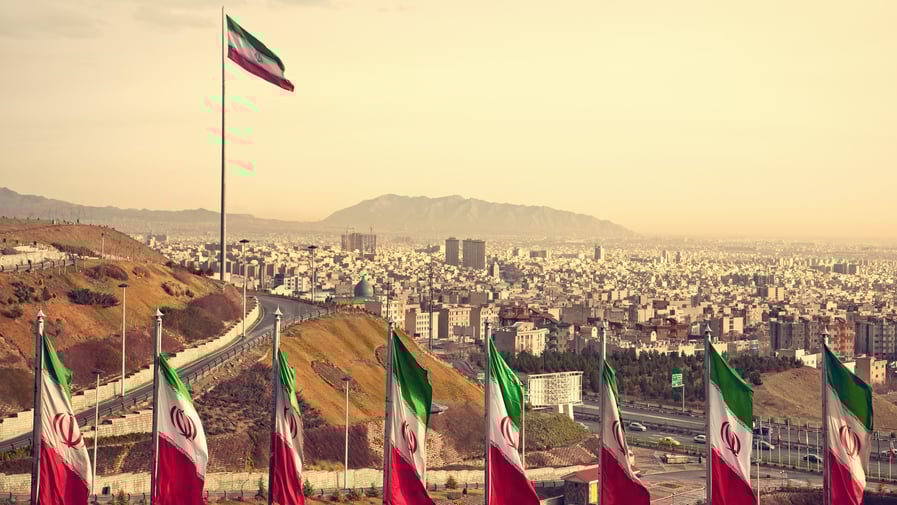
In January 2026, countrywide anti-government protests – alongside the threat of US military intervention – raised the prospect of potential regime change in Iran. Tamsin Hunt examines the dynamics that made this movement different from previous protests in Iran, and the drivers that could trigger further shifts in Iran’s political and security environment over the coming year.
On 28 December 2025, the shopkeepers of Tehran’s Grand Bazaar initiated what was soon to become Iran’s largest anti-government movement since 2022. Protests were initially triggered by a steep currency depreciation – one of several in recent months – and high inflation that has made essential goods like food and fuel unattainable for many. Furthermore, a deepening water crisis, electricity shortages, high unemployment, and systemic corruption served to compound popular grievances and ignite demonstrations across the country. These immediate and tangible issues, however, fall within a broader context of a weakened Iranian regime eroded by: military conflict with Israel (and the US) in mid-2025; a loss of regional allies; speculation and political manoeuvring over the succession of 86-year-old Supreme Leader Ayatollah Ali Khamenei; and years-long tightening of international sanctions, declining currency reserves, and an inability to access billions in funds overseas.
The Iranian regime has weathered previous anti-government and reformist movements, driven by similar themes around social freedoms and economic reforms. Now, however, rising doubt around the government’s ability to manage this latest crisis has challenged the regime and brought to the fore a more realistic prospect of political change than past movements. Additionally, the situation has been further impacted by the US warning of "strong" military intervention if demonstrators are killed, and reciprocal Iranian warnings of attacks against US allies and assets in the region, raising the potential for renewed regional conflict of a scale similar to June 2025.
For now, it appears that the country’s security forces have contained the protests, at least in the short term; thousands are estimated to have been arrested or killed in the government’s clampdown, and both the US and Iran have de-escalated rhetoric around military conflict. Additionally, in attempting to address the economic crisis, authorities have implemented some measures, such as raising taxes and reforming the subsidy system. However, without deep structural reform, these measures are unlikely to ease economic pressure on households over the coming months and years, nor bring fundamental improvements to Iran’s infrastructure issues. Moreover, persisting tensions between Iran, the US, and Israel will continue to drive an expansion of pressure tactics like economic sanctions and recurring fears of regional conflict, leaving the Iranian regime ever more vulnerable to collapse.
Drivers of change
Although protests largely appear to have subsided, we will continue to monitor key factors that may trigger renewed protest activity in Iran:
Deepening socio-political fissures
The Islamic Republic has historically maintained authority through security, controlled political competition through reformists and hardliner factions, subsidised goods, and state employment. Currency collapse, galloping inflation, entrenched corruption among regime-connected elites, and deteriorating public services have alienated wider segments of Iranian society that previously benefited from the system. Multiple sources report that this wave of protests has occurred in all 31 provinces, representing an unprecedented geographic scale. The high number of casualties, both among protesters and security forces, has also surpassed those recorded during the protest waves of 2019 and 2022. The current wave of protests began with Tehran’s bazaar merchants – one of the clerical class’s closest allies who ignited the 1979 revolution. This broad-based anger is also amplified by ethnic and religious diversity in Iran where the percentage of Persians ranges from 50 to 65 percent of the population. Long-term socio-political issues remain one of the key drivers of discontent in Iran.
Regime cohesion
Security force cohesion remains the regime’s pillar of stability. Historically, regime collapse in similar contexts has been preceded by significant defections. However, Iran has so far not witnessed such fractures during this or previous waves of unrest. Additionally, there is currently no indication that demonstrators have retained any territorial gains, despite earlier claims of territorial control over two towns in western Iran's Kurdish region. This contrasts, for example, with protest dynamics in Syria and Libya in 2011-12. The current wave of demonstrations, however, characterised by an exceptionally high rate of casualties among security forces — over 114 deaths compared to 70 during the 2022-23 protests — has increased the risk of regime defections in the event of prolonged unrest.
US military intervention
A potential US military action remains a pivotal factor that could alter Iran’s internal trajectory over the medium to long term. While immediate large-scale operations appear less likely than in early January, Washington’s capacity to conduct a military operation weighs over Tehran’s strategic calculus. Potential options include airstrikes targeting command centres and energy facilities, targeted cyberattacks, and no-fly zones over certain provinces. Such measures would not only bolster the protesters’ morale but also degrade the regime’s operational capabilities. Despite the US administration signalling openness to de-escalation, military preparations continue, with the Pentagon deploying and repositioning additional US troops and military equipment to the Middle East. As witnessed in the lead-up to the June 2025 conflict and more recently in Venezuela, the current US administration prefers to maintain strategic ambiguity, with military deployments potentially persisting for months.
Regional and commercial implications
In the event of regime collapse in Iran, the repercussions could be significant, highly volatile, and would stretch across the region. Internal divisions between ethnic groups – including Persian, Kurdish, Azeri and Baluch – could lead to prolonged civil conflict. More broadly, largescale refugee flows across Iran’s land and sea borders have the potential to destabilise already-fragile states, such as Pakistan, Afghanistan and Iraq, while also increasing pressure on Turkey and Gulf states.
Additionally, should the US intervene militarily, countries that house US military assets in the region may further come into direct line of retaliatory fire from Iran – as Qatar did in June 2025 – while the impact of war would be felt globally, in trade and travel disruptions.
 Aviation and travel
Recurring airspace and border closures above Iran and its regional neighbours would drive significant travel disruptions during periods of elevated tension. Border closures would make evacuations challenging, cancelled flights would leave thousands of passengers stranded, and diversions to flight paths would drive travel delays and disruptions globally.
 Oil and shipping
The Iranian-controlled Strait of Hormuz accounts for between 20 and 25 percent of the world’s seaborne oil and gas, while the Persian Gulf and Red Sea are key shipping lanes for trade between Europe, the Middle East and Asia. Iran-backed Houthis in Yemen might also resume their attacks on commercial shipping in the Red Sea in the case of US military action against Iran. Ongoing conflict concerns would drive periodic surges in oil prices, freight costs and war-risk insurance, while rerouting ships around the Cape of Good Hope also increases travel times and operating costs.
We will be closely monitoring developments in the region. Please reach out to our experts if your organisation is impacted by any of the issues discussed in this article