Neo Tsotetsi discusses the recent resurgence of conflict in northern Ethiopia amid long-simmering tensions between the Ethiopian government and Tigray People’s Liberation Front (TPLF), and explores the impact both parties’ deepening foreign alliances stand to have on the country’s fraught security landscape.
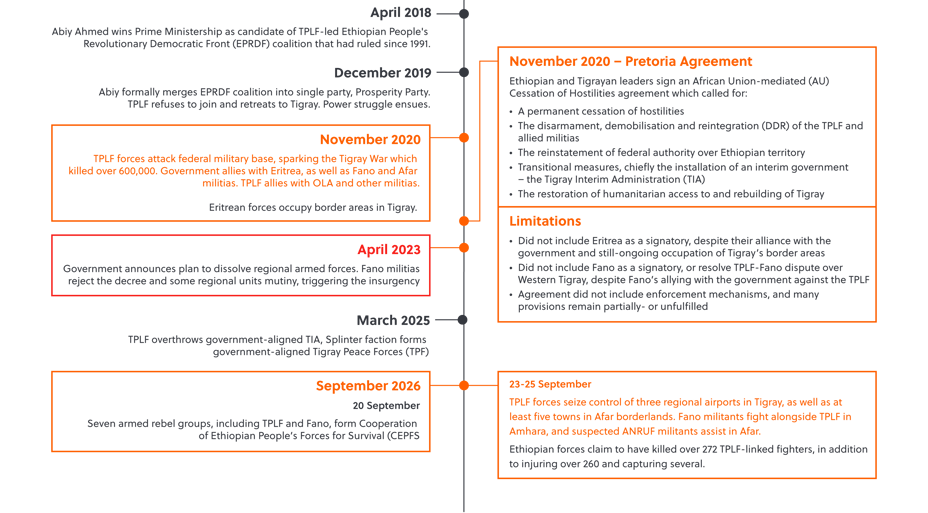
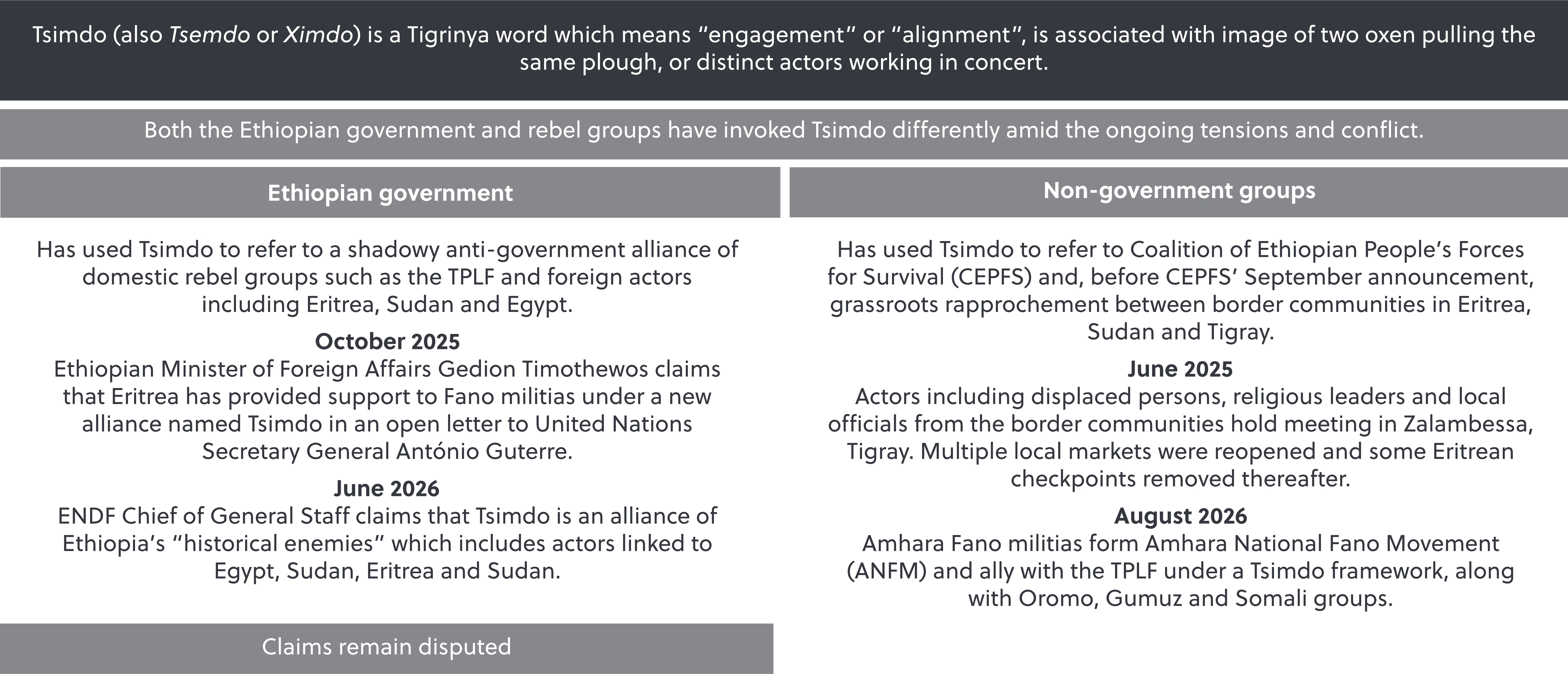
On 23 September, the TPLF declared it had entered a “defensive war” with Ethiopia’s federal government after seizing three airports across Tigray, including Alula Aba Nega Airport in Mekelle. The TPLF said it was responding to federal drone, artillery and ground attacks, while the federal government maintained that Tigrayan forces had initiated the escalation. Clashes have subsequently spread into neighbouring Amhara and Afar regions, marking the most serious escalation since the 2020–22 Tigray War. Relations between the Prosperity Party-led (PP) federal government and the TPLF have remained deeply adversarial in the years following, with both competing for political and military influence. Tensions have also periodically triggered localised clashes and federal drone strikes on Mekelle. However, the late-September formation of the Coalition of Ethiopian People’s Forces for Survival (CEPFS) — a seven-member rebel alliance, also referred to as Tsimdo, whose stated aim is to remove Prime Minister Abiy Ahmed’s government — has raised the stakes considerably. Despite its bringing together a diverse range of local armed groups, the fragile alliance only papers over Ethiopia’s longstanding political and security divisions, while the increasingly fraught geopolitical environment threatens to deepen them.
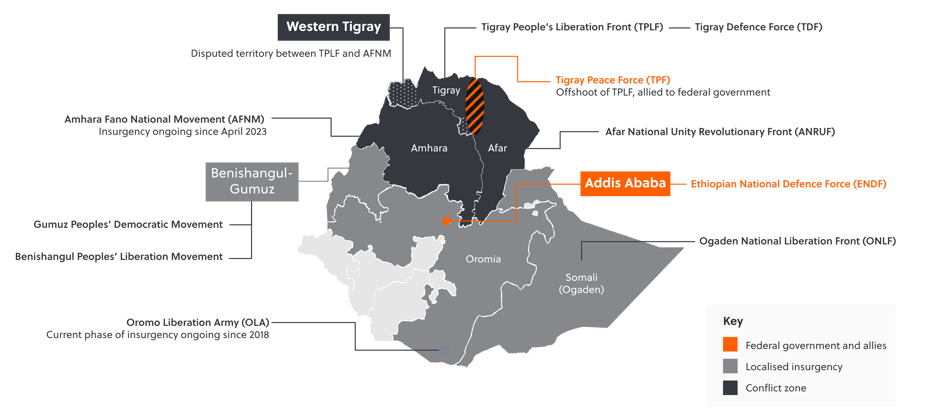
Conflict dynamics in Ethiopia
Including Cooperative of Ethiopian People’s Forces for Survival (CEPFS) members
A marriage of (in)convenience
Though the CEPFS presents itself a coalescence of Ethiopia’s disparate rebel groups into a united anti-PP and -Abiy front, the alliance itself is more likely opportunistic and tactical than a genuinely aligned partnership. Several major insurgent groups have joined as members, including the Amhara National Fano Movement (ANFM) and Oromo Liberation Army (OLA). However, it is only the latter that had – albeit loosely – allied with the TPLF during the 2020-2022 war, while the groups that now form part of the ANFM actively fought against the TPLF, and retain contentious claims on disputed territory in western and southern Tigray. This creates a fundamental tension at the heart of the coalition: maintaining unity against a common adversary while managing competing interests among its own members.
These divisions are also likely to complicate military coordination. Most of the alliance's constituent groups have little experience conducting joint operations, while disparities in manpower, resources and capabilities risk creating unequal burdens on the battlefield. The geographic distance between their respective areas of influence – the TPLF and Ogaden National Liberation Front (ONLF), for example, operate on opposite sides of the country – further constrains coordination, making it difficult to synchronise offensives or establish effective command-and-control structures. Consequently, while the alliance increases pressure on the federal government, its long-term effectiveness will depend on whether its members can sustain cooperation beyond their immediate opposition to Addis Ababa.
Tensions between TPLF and Ethiopian government
Fuel to the fire
Tensions in the Horn of Africa
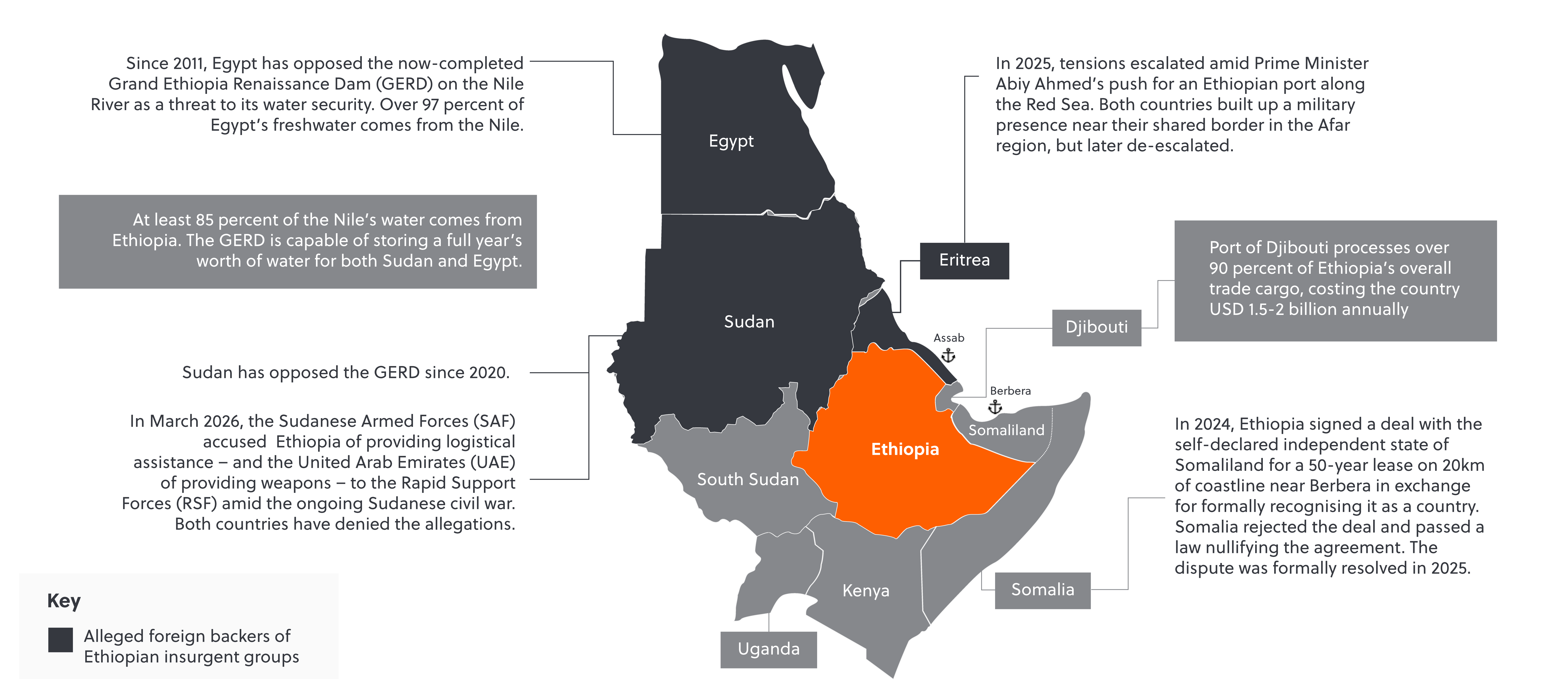
The conflict also risks being prolonged by worsening regional tensions. Addis Ababa’s increasingly assertive pursuit of sovereign access to the Red Sea – particularly through Eritrea’s port of Assab – has sharpened tensions with Asmara, which views such rhetoric as a potential threat to its sovereignty. Relations are further strained by Eritrea’s exclusion from the 2022 Pretoria peace process, despite its military role in the Tigray War, and by mutual allegations that both Addis Ababa and Asmara have supported armed groups in each other’s territory. In building the Grand Ethiopian Renaissance Dam (GERD) on the Blue Nile, Ethiopia has also faced growing friction with Egypt and Sudan, the latter of whom has accused Addis Ababa of supporting the Rapid Support Forces during Sudan’s civil war. Ethiopia has similarly accused Egypt and Sudan of backing rebels in its territory in recent weeks, attributing the TPLF's early successes to this support. Though these claims remain contested, they underscore the depth of mutual distrust in the region.
Competing for the meaning of Tsimdo
Neither Ethiopia nor its perceived adversaries are likely to seek direct interstate conflict in the immediate term given the potentially severe military, economic and humanitarian costs. However, regional actors may seek to constrain Ethiopian influence through support for armed proxies at lower risk. This risk is reinforced by wider Gulf competition: the United Arab Emirates (UAE) has close ties with Addis Ababa and faces allegations of support for Sudan’s RSF, while Saudi Arabia has generally aligned more closely with Egypt, Eritrea and Sudan’s military authorities. The emergence of the CEPFS therefore provides a more visible potential vehicle for external support, increasing the risk that Ethiopia’s internal conflict becomes entangled with regional and Middle Eastern rivalries, and more difficult to resolve.
Old rivalries, new dynamics
Although comparisons with the Tigray War are inevitable, the current conflict is unfolding under different conditions. The emergence of CEPFS creates additional pressure points for the federal government across multiple regions, but it remains unclear whether the alliance can translate its shared opposition to Abiy into sustained military coordination. At the same time, the ENDF enters this phase of the conflict with a significant advantage in its expanded aerial capabilities, allowing it to conduct long-range strikes and support ground operations with far less reliance on large-scale troop deployments than during previous campaigns. Yet military superiority alone is unlikely to produce a quick resolution. Deep-rooted local grievances, growing regional rivalries and the potential for external support to flow towards anti-government groups all point towards a protracted and increasingly complex conflict environment. While the situation remains highly fluid, Ethiopia appears set for a sustained period of instability at a time when international actors have both limited capacity and diminishing appetite to broker a durable political settlement.
%20bw%20-%20gsi.jpg?width=121&height=121&name=S-RM-Neo%20Tsotetsi-9179-Edit%20(1)%20bw%20-%20gsi.jpg)