Throughout 2025, Ahlus Sunnah wal Jamaah rebels demonstrated a renewed interest in local fundraising, specifically seeking to make inroads with Cabo Delgado’s artisanal miners to open a new revenue stream. Neo Tsotetsi examines the nascent emergence of this alliance, and the threat it may come to pose to foreign-owned mining companies across the province.
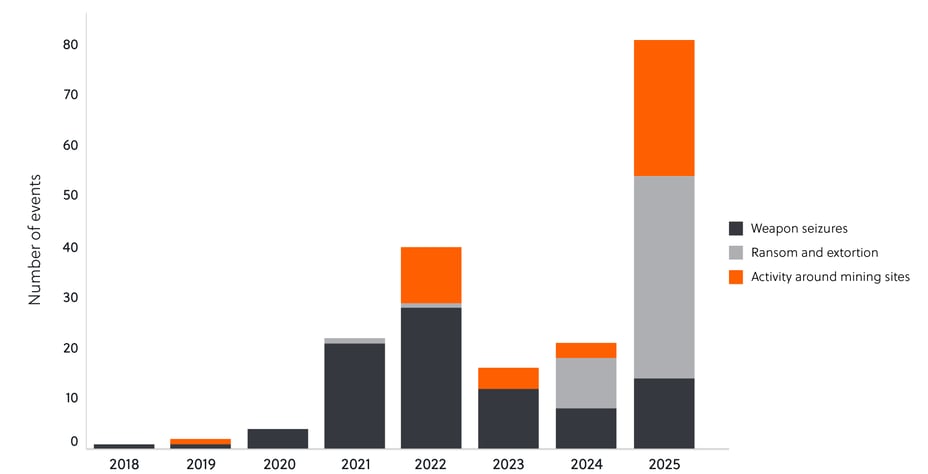
In 2025, Islamic State (IS) affiliate Ahlus Sunnah wal Jamaah (ASWJ) increased its fundraising activities by at least 300 percent compared to the previous year. The bulk of this has been through illegal roadblocks, which militants use to extract ‘tolls’ and conduct express kidnappings. Remaining highly mobile has been key in this effort: ASWJ controls little territory – even in its core areas of operation in the districts of Macomia, Muidumbe and Mocímboa da Praia – making the ability to retreat quickly after an attack central to its survival. However, the biggest shift has been in its fundraising around small-scale and artisanal mining sites across Cabo Delgado Province. Where ASWJ typically would have fundraised in short burst campaigns, militants are seeking a longer-term presence and, instead of relying on violence to speed up payments, militants have used it sparingly. Set against the backdrop of a 60 percent rise in gold prices in 2025, the shifting tactics begin to suggest a change in strategy: where ASWJ would otherwise “hit-and-run”, it may instead seek to partner.
ASWJ fundraising activities in Cabo Delgado
Source: ACLED
The appeal of a shared enemy
This would be, at the least, ASWJ’s second attempt to curry favour with local communities in recent years. ASWJ briefly adopted a ‘hearts-and-minds’ approach in early 2023, a decision likely spurred by the successive losses the group was suffering at the hands of Mozambican, Rwandan and Southern African Development Community (SADC) Mission in Mozambique (SAMIM) forces at the time. This included downscaling violence in favour of proselytising, trading with locals by selling cheap and buying at above-market prices, and reassuring communities they shared a common enemy in the government, which ASWJ framed as failing and oppressing the people of Cabo Delgado. This approach facilitated a modest resurgence between late 2023 and early 2024 as the group continued to gain members. However, this outreach was effectively abandoned after a mid-2024 change in leadership, with recruitment needs dropping notably after SAMIM’s withdrawal in July 2024.
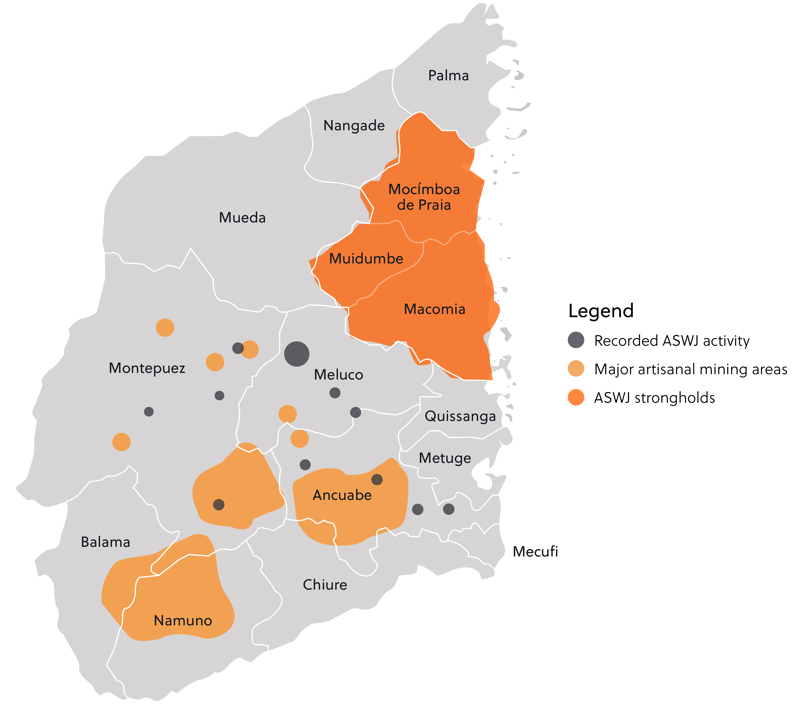
This new outreach targets a friendlier population: artisanal miners, a group ASWJ has historically recruited from. Given the group’s limited territorial control and few revenue streams, it is unlikely it is seeking to recruit at this point. Rather, the more likely goal is to impose a protection racket while positioning itself as a partner for miners. Al Qaeda affiliate Jama'at Nusrat al-Islam wal-Muslimin (JNIM) has established such a model in the Sahel, controlling access and transport to and from mining sites to profit without entering the sector. However, JNIM’s racket was established with force, which would be difficult for ASWJ given its low headcount – 100 near the mines, 300 overall. What would be more feasible, if not already in action, is a partnership-focussed approach sustained by threats – but limited use – of violence, as well as shared anti-government sentiment. In this framework, ASWJ’s demonstrated willingness to refrain from “unjustified” violence would allow the group to portray itself as more reliable and less dangerous than security forces, making the group more likely to gain a foothold – and possible acceptance – among miners.
ASWJ activity at artisanal mines
2025
A perfect storm
Such a partnership would stand to significantly elevate the threat ASWJ poses to mining companies in the region. At present, the price of gold, as well as Cabo Delgado’s abundance of gemstone deposits, already makes such mines an attractive target. ASWJ has attacked several foreign-owned mines in recent years, including July and October 2022 attacks near a ruby mine in Montepuez District which killed several workers and forced brief evacuations. Despite not directly attacking the site, IS propaganda outlets reported both as part of its ‘anti-colonial’ efforts, demonstrating how ASWJ can capitalise on local grievances against foreign-owned companies. The income ASWJ stands to make from artisanal miners alone would upgrade the group’s capabilities, for example, unlocking access to more or better weapons. However, should this alliance begin to solidify, ASWJ would be able to fund a sustained recruitment drive, reducing its reliance on mobility for fundraising and enabling more geographically stable racketeering. Additionally, given the history of artisanal miner-led invasions of foreign-owned mines, ASWJ’s growing presence in this sector stands not only to drive further such attacks, but possibly augment and support them as part of the group’s growing revenue streams.
%20bw%20-%20gsi.jpg?width=121&height=121&name=S-RM-Neo%20Tsotetsi-9179-Edit%20(1)%20bw%20-%20gsi.jpg)