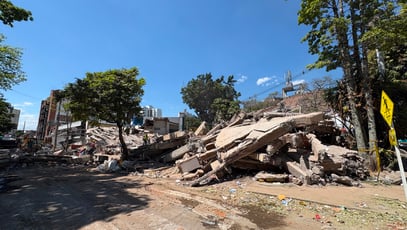
In this edition of the Global Risk Bulletin, we explore the (geo)political, security and economic dynamics of the Middle East conflict, which began in late-February 2026 as Iran launched retaliatory strikes against Gulf states in response to the US and Israel’s coordinated heavy targeting of sites across Iran. We reflect on the Iranian regime’s challenges in maintaining control amid the loss of several key leadership figures, and consider the geopolitical dynamics among Gulf states as they navigate an unpredictable environment. We also explore the war’s impact on the global commercial landscape, and look at the wider security challenges that may stem from the conflict, regionally and abroad.
World news in brief
A roundup of key political violence developments globally. Read this article
Cracking foundations: Iran’s waning internal stability, exacerbated by war
The Iranian regime’s focus on regime survival since the 1979 Islamic Revolution has driven the growth of a sprawling security establishment to maintain its authority. The war with US and Israel has challenged this dynamic amid the loss of key politicians, the creeping power of the Islamic Revolutionary Guard Corps, and widespread internal opposition. Read this article
Under fire: Gulf states caught between US-Iran tensions
The war between Iran, Israel and the US has driven unprecedented security and economic challenges for Gulf states. These countries face significant challenges in navigating the fast-changing geopolitical landscape, and re-establishing their reputations as safe and stable commercial hubs over the coming months. Read this article
Beyond the Strait: How the Iran conflict is rewiring global commercial risk
The conflict in the Middle East has already had global commercial reverberations, spiking energy prices and disrupting logistics and supply chains. Regardless of a potential de-escalation, severe disruptions and resulting market volatility are likely to persist. Read this article
Faultlines: The wider security implications of the Iran conflict
Even if the conflict subsides, sustained tensions among key actors could continue to challenge stability in regional flashpoints like Lebanon, the Red Sea and Bab El Mandeb Strait, and heighten the potential for extremism, sabotage and other grey-zone tactics abroad. Read this article