Illegal mining has proliferated across South Africa in recent years. Tamsin Hunt examines the ongoing security risks posed to commercial operators in South Africa’s mining sector despite recent law enforcement efforts under Operation Prosper.
South Africa’s illegal mining crisis is no longer an underground problem; it is a violent and vast organised criminal economy, exposing the limits of the country’s recent law enforcement response. In August 2026, South African President Cyril Ramaphosa announced that Operation Prosper – the joint military and police initiative against illegal mining – has “disrupted the operational and financial lifelines of illegal mining networks.” As part of the countrywide operation, security forces have arrested more than 1,000 illegal miners; confiscated dozens of weapons; seized thousands of kilograms of gold-bearing material; and closed several illegal mining shafts.
These gains, however, are unlikely to meaningfully disrupt the estimated 30,000 illegal miners – locally known as Zama Zamas, an isiZulu term for ‘to try’ or ‘take a chance’ – operating across the country, tapping into the country’s large reserves of gold and other precious materials. Miners are often motivated by a desperate effort to – as their name suggests – try escape from poverty. Typically employed by larger organised cartels, Zama Zamas can spend up to several months underground, occupying long-abandoned mining shafts, digging new tunnels, or even hijacking active (usually small-scale) commercial mines. The practice is particularly prevalent along key mining belts in the provinces of Gauteng, North West, and Free State, costing formal mining companies and the state a combined USD 1.5 billion per year in lost revenue, taxes, and royalties.
Security risks and environmental fallout
In addition to the economic impact, illegal mining operations pose significant security and environmental risks to mining companies and surrounding communities.
- Security. Zama Zamas are often well armed with assault rifles and explosives, and clashes with police and private security personnel regularly result in casualties. In June 2022, for instance, dozens of Zama Zamas stormed a deactivated mine in Randfontein, Gauteng Province, in efforts to force access to the shaft. Armed clashes broke out with the mine’s private security team, and one employee was shot and killed.
- Crime. Illegal mining also incentivises broader criminal activity, such as theft of fuel, explosives, copper cables, and mining equipment. Inter-gang competition too, often escalates into armed clashes, posing significant safety risks to bystanders and residents.
- Environment. Unregulated small-scale mining can cause severe soil erosion and deforestation. Moreover, miners typically use dangerous chemicals – including sodium cyanide and mercury – in processing mining material, and often near critical water sources, leading to community concerns around water contamination.
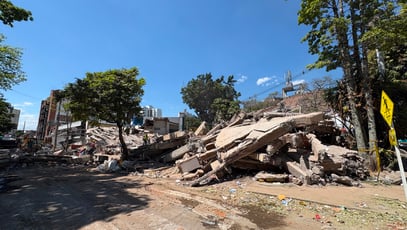
- Infrastructure. Illegal mining activity is not restricted only to unused or abandoned shafts, with miners often digging new tunnels to access a shaft, or to branch off one, posing a threat to the infrastructure above. This issue is particularly pronounced in Johannesburg, a city built on large gold reserves, where new tunnels are causing damage to underground infrastructure; opening cracks and sinkholes in roads; and leaving homes and other buildings at risk of collapse.
A multifaceted problem
Operation Prosper is just one initiative through which South Africa’s government plans to clamp down on illegal mining. In August 2026, the Department of Justice published the General (Mining) Laws Amendment Bill for public comment, proposing the introduction of harsher penalties, including imprisonment of up to 30 years and fines of up to USD 6 million, increased police powers, and a framework for regulating small-scale and artisanal mining. However, this illicit industry is vast in nature – with thousands of abandoned and inadequately secured mining shafts across the country – and deep institutional weaknesses in South Africa’s police and judiciary, including pervasive corruption and under-resourcing, will severely limit enforcement capacity.
At the same time, illegal mining activities have become increasingly sophisticated, directed by complex criminal networks that control access to mining sites, organise food and supplies for miners underground, operate wider activities like money laundering and recruitment, and organise the processing, transport, and export of the extracted minerals. Without a multi-pronged approach towards dismantling every level of the operation – and easing systemic poverty in surrounding communities – commercial mining operators will continue to face security challenges such as armed incursions on their active and inactive shafts, with associated safety risks to staff. Local communities, meanwhile, will shoulder the costs of rising crime and environmental damage, and the miners themselves will continue to endure dangerous and often lethal conditions in the hope of finding gold, and with it, economic freedom.