The recent detention of Afghan UN personnel highlights the continued unpredictability of the Taliban’s security enforcement in Afghanistan. Despite the Taliban’s appetite for increased international engagement, including with the US, wrongful detention is likely to remain a key tool of the regime to maintain political control over humanitarian activity in the country, writes Shannon Lorimer.
In early August, the Taliban detained two Afghan staff members of the UN Assistance Mission in Afghanistan (UNAMA) in Herat. The staff members were released in late August, with authorities giving no reason for the arrests. The incident highlights the Taliban’s continued use of arbitrary detentions and opaque security enforcement to reinforce its control over the aid sector, and pressure international organisations to operate within Taliban-defined boundaries. This includes restrictions on what they can do, who they can employ and over activities considered politically or socially sensitive. The detentions come several months after the US’s designation of Afghanistan as a state sponsor of wrongful detention in March 2026, underscoring the Taliban’s frequent use of detention in targeting foreign and local humanitarian personnel.
An uncertain operating environment
Since the collapse of Afghanistan’s democratic government and the Taliban's capture of the country in 2021, the operating environment for the humanitarian sector has become highly constrained, with organisations experiencing tighter restrictions, a decline in international funding and frequent interference in their activities. Nevertheless, as of 2026, multiple international NGOs remain in the country, alongside national NGOs, operating under these challenging circumstances. While some foreign nationals have remained in the country, they now represent a relatively small proportion of the overall humanitarian workers. Afghanistan’s security environment is entirely controlled by the Taliban and managed according to the regime’s strict preferences rather than according to a predictable and transparent system based on the rule of law. In this environment, the Taliban have frequently targeted human rights activists and aid workers. However, arbitrary detentions are at the extreme side of a broader spectrum of state interference, which also manifests as questioning, unpredictable enforcement of morality rules, office raids, restrictions on female employees and on their movements, demands for access to staff information and the use of violence against aid workers. These measures are used for the purpose of coercing humanitarian and civil-society actors in the country.
The UN Office for the Coordination of Humanitarian Affairs (OCHA) records these as “access incidents” and frequently reports several dozen such incidents a month. While these have declined in recent months, the UN has previously attributed such declines to the reduction in humanitarian activities caused by funding shortages, driving down opportunities for interference, rather than a shift in Taliban mentality towards the aid sector. Meanwhile, the number of detentions remains consistently high.
Interference in humanitarian assistance in Afghanistan
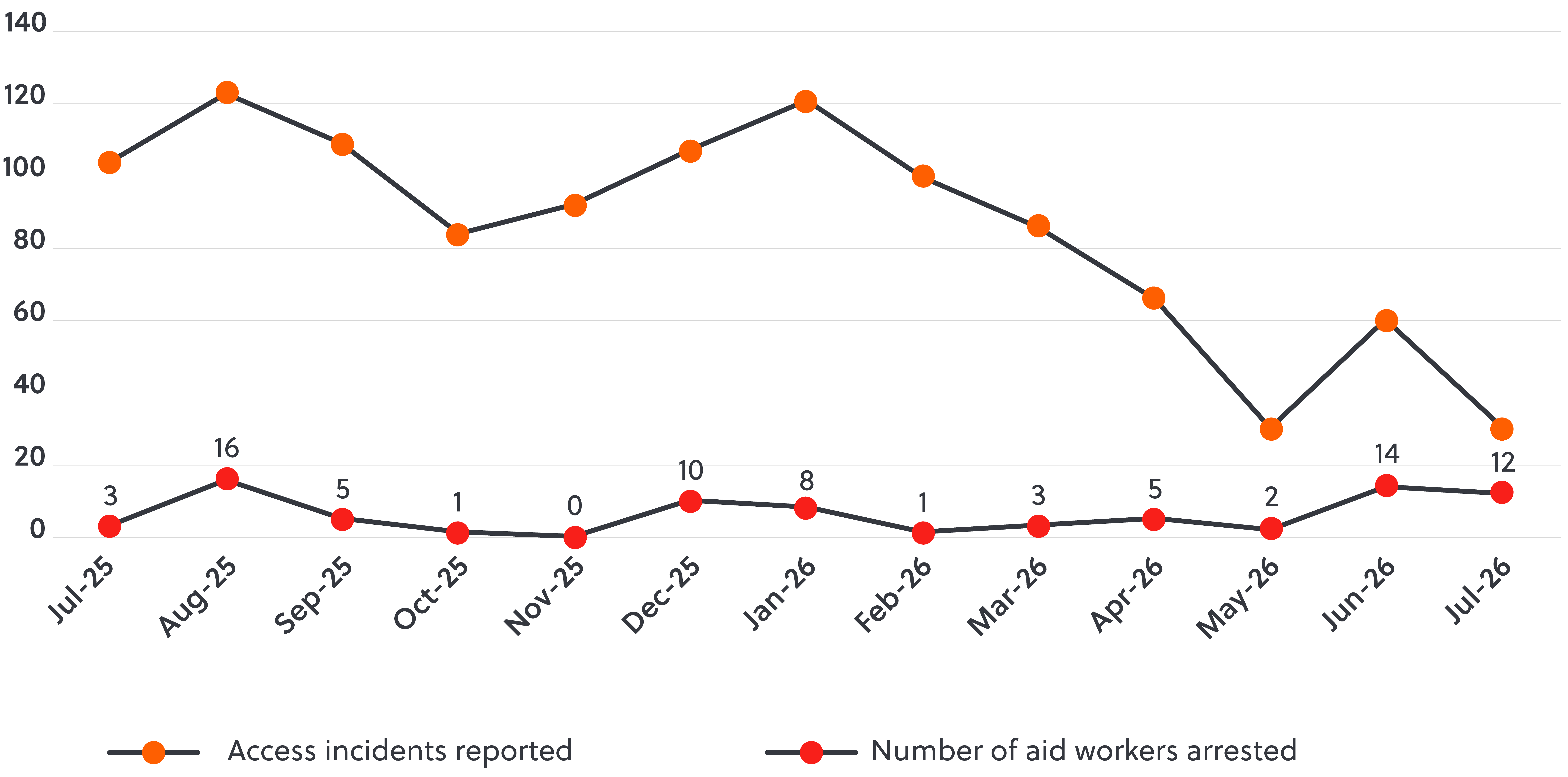
Source: UN Office for the Coordination of Humanitarian Affairs
Although the Taliban have typically arrested foreign workers on charges of espionage or terrorism, local nationals are typically detained through ordinary mechanisms, including over alleged non-compliance with Taliban regulations, including dress or gender, as the basis for arrest. This creates significant uncertainty for NGOs; the rules are deliberately difficult to navigate, and the boundary between routine regulatory enforcement and politically motivated detention is blurred.
Increased international engagement
The detentions come despite the Taliban’s ongoing efforts to move away from its diplomatic and economic isolation. While it has seen some success in strengthening ties with Russia, who formally recognised the Taliban government in 2025, and announced plans in May 2026 to develop a full-fledged partnership with the Taliban, its attempts to normalise relations with the US have been unsuccessful. These efforts have included offering US companies access to Afghanistan’s estimated USD 1 trillion in untapped mineral resources in efforts to ease economic sanctions and normalise relations. However, it has so far not suspended practices like wrongful detention, leading to the US designating Afghanistan as a state sponsor of wrongful detention in March. The designation singles out Afghanistan for detaining US nationals in efforts to extract policy concessions and aims to increase pressure on the Taliban to stop taking US nationals hostage or face penalties. Despite the release of a US national in March 2026, two other US nationals are reportedly still being held in Afghanistan. The Taliban’s attempts to normalise relations with the US in spite of these detentions highlight the contradiction between its desire for increased foreign capital and diplomatic engagement, and its intention to retain firm control over humanitarian activities.
Continued unpredictability
Although the Taliban have shown some willingness to encourage foreign investment and expand international engagement, including with the US, continued detentions show that maintaining control over the humanitarian organisations’ mandates remains a priority. This tension is likely to persist: humanitarian organisations may be permitted to operate, but only under continued interference and restrictions.