The war between Iran, Israel and the US has driven unprecedented security and economic challenges for Gulf states. Tamsin Hunt considers the shifting geopolitical positions of Gulf countries as these states try to re-establish stability, reassure investors, and shield against future conflict.
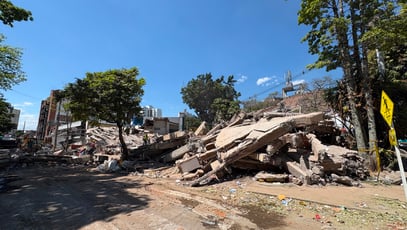
Since 28 February, Gulf states have come under direct attack, affecting their long-crafted reputations as safe havens for global commerce, finance, energy, aviation and tourism. Amid its war with Israel and the US, Iran has struck out across the region. Hundreds of drones and missiles have targeted not only US-linked military and commercial interests, but also the Gulf’s oil and gas refineries; electricity power lines; ports and vessels; airports; hotels and luxury apartment buildings; and data centres operated by multinational technology companies. While Iran and the US have agreed to a two-week ceasefire from 7 April, it is unclear that this will significantly ease Gulf states’ security concerns, with negotiations towards a firmer peace deal anticipated to be a contested affair.
Until this conflict, Gulf states had shielded themselves from regional instability through a strategic combination of military partnerships with the US, cautious rapprochement with Iran, and warming economic ties between some states and Israel. However, the wide nature of this latest conflict – and its unprecedented economic impact – has amplified the challenges facing the Gulf in balancing their relationships with other countries regularly at odds with one another, and raised speculation around a potential recalibration during and after the war.
Geopolitical recalibration under increasing economic pressure
Iran’s attacks on its Gulf neighbours and their maritime trade routes have had an immense impact on their respective economies. The oil trade represents nearly 25 percent of the GDP of the six members of the Gulf Cooperation Council (GCC), Qatar, Kuwait, Bahrain, Saudi Arabia, the UAE, and Oman. Three countries, Qatar, Kuwait and Bahrain, are particularly exposed to regional disruption, geographically unable to reroute oil tankers past the critical chokepoint of the Strait of Hormuz. Although Iran agreed to reopen the strait under the tentative April agreement with the US, its willingness to leverage the shipping channel will drive a continued threat of economic damage to the Gulf should further negotiations sour.
Additionally, Iran’s attacks have undermined the GCC’s efforts to diversify their economies through tourism, business, logistics, and technology. Airspace closures and flight cancellations brought travel to a near standstill across the region, major international banks and consultancy firms closed their offices and advised staff to work from home, and reports have emerged that several wealthy investors and entrepreneurs reallocated financial assets out of the region. Furthermore, this conflict has served to expose deeper vulnerabilities across Gulf countries, including their dependence on food imports – with more 70 percent shipped through the Strait of Hormuz – and their reliance on desalination plants for water supply.
Once the dust has settled, the Gulf states will seek to re-establish their reputation for safety and stability and limit the impact on tourist and investor confidence as much as possible."
Gulf defences have intercepted most of Iran’s missile attacks, allowing the vast majority of regional infrastructure to remain operational, at least to some extent, while several governments also introduced measures to weather the economic storm. Qatar, for instance, assured residents that there is no danger of food shortages due to diversified logistics routes and effective emergency management plans; Saudi Arabia and the UAE leveraged extensive pipeline networks to bypass the Strait of Hormuz; and the UAE’s central bank launched a ‘resilience package’ to support the banking sector and preserve economic stability. Should the April truce extend or a more permanent agreement materialise, regional flight paths will reopen, and maritime trade through the Strait of Hormuz will likely resume. Once the dust has settled, the Gulf states will seek to re-establish their reputation for safety and stability and limit the impact on tourist and investor confidence as much as possible.
The Gulf states’ ability to fully recover and future-proof their position, however, will depend heavily on their capacity to navigate the fast-changing security and geopolitical landscape over months and years to come.
Reshaping the Gulf’s security landscape
Gulf states have historically been close allies of the US, with their security architecture relying substantially on US security guarantees and the hosting of US and other foreign troops in the Middle East. However, the US’s recalibration of its security strategy – in progress since President Barack Obama’s administration – has brought this reliance increasingly to the fore.
Gulf countries are unlikely to break ties with the US – with war only serving to underscore the their need for US weapons and defence systems – but efforts to diversify security ties will likely accelerate after this latest conflict draws to a close."
Growing discomfort around Israeli, US, and Iranian decision-making, alongside uncertainty around the trajectory of regional tensions – including a potential for sustained instability and recurring conflict – have triggered efforts by Gulf states to diversify and strengthen defence cooperation regionally and externally. Saudi Arabia, for instance, has reached out to Turkey and Pakistan to deepen trade between their respective defence sectors; the UAE has expanded its procurement of defence and surveillance systems from South Korea in recent years; Kuwait has built an ammunition factory with joint support from China; and Bahrain has sought stronger defence ties with India. Ukraine, too, has provided expertise to at least four Gulf states – the UAE, Saudi Arabia, Qatar and Kuwait – on defence against Iranian Shahed drones, the same type of weapon regularly used by Russia against Ukraine. Gulf countries are unlikely to break ties with the US – with war only serving to underscore the need for US weapons and defence systems – but efforts to diversify security ties will likely accelerate after this latest conflict draws to a close.
Geopolitical position in a region at war
This conflict will have far-reaching repercussions for the Gulf region’s stability and its geopolitical position going forward, and the damage to Iran’s relations with its Gulf neighbours will not easily be repaired. Prior to 28 February, long-fraught relations between Iran and the Gulf states had eased considerably; all aside from Bahrain had restored diplomatic ties with Iran, including, most recently, Saudi Arabia in March 2023. Gulf countries initially took a firmly neutral stance in the conflict, prohibiting US attacks on Iran from their territories, but weeks later, this policy had shifted noticeably. Saudi Arabia allowed the US to use its King Fahd Air Base in Taif, Mecca Province, several missile launches have reportedly originated from Bahrain, and the UAE – a hub for Iranian business – began clamping down on Iranian financial assets within its borders.
The April ceasefire agreement, which is likely to leave the Iranian regime intact and capable of attacking the Gulf again, presents significant security challenges for the region. The UAE in particular – suffering the brunt of Iran’s attacks on the Gulf – has been particularly outspoken over its deepening distrust of Iran, stating a new willingness to participate in US-led maritime security operations going forward. With regional geopolitical relationships severely eroded, and an Iranian regime (should it survive the coming months) left weakened and angry, the Gulf will remain a credible target beyond this latest conflict, and these countries’ travel, business, and trade sectors will remain at risk of collateral damage during future hostilities.